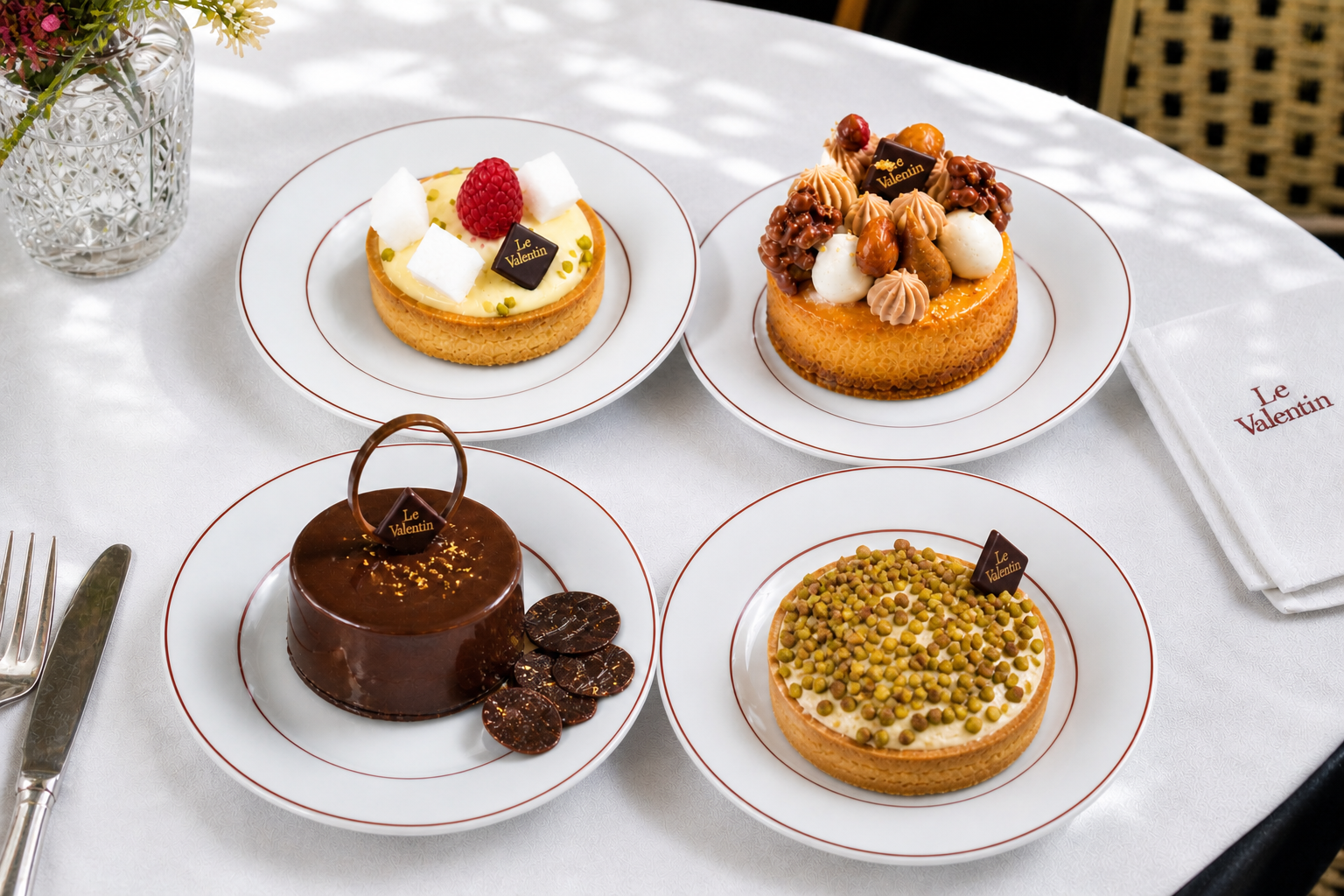
A family-run tearoom, artisan patisserie and restaurant founded several decades ago and subsequently taken over by the owners’ son, Le Valentin now operates two restaurants in two nineteenth-century Parisian settings: Galerie Vivienne, one of the city’s finest covered passages, a short walk from the Palais Royal and the Louvre, and Passage Jouffroy, next to the Musée Grévin.
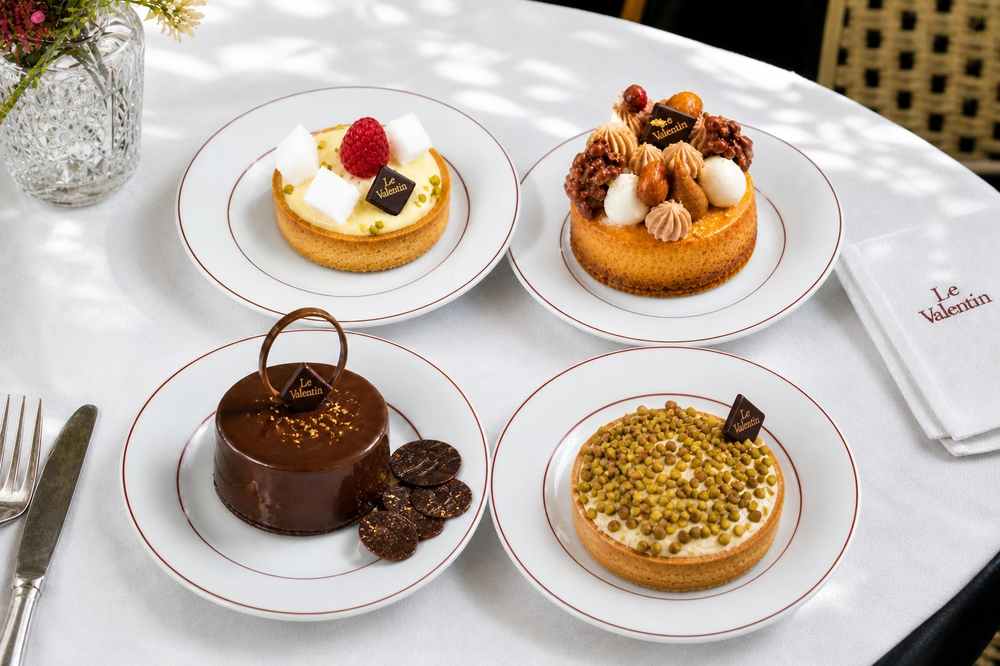
Head pastry chef Bruno Collard and his team make every croissant, pastry, confection, brunch and lunch served to guests on site each day. The press has repeatedly celebrated the address as a rarity: Le Monde calls it “delightfully old-fashioned”, Petit Futé notes that its croissants rank among the best in France, and Vosges Matin describes it as a “little embassy of Lorraine” in Paris, among many other accolades.
Far removed from Instagram-led restaurant concepts that last three seasons before changing their name in the fourth, Le Valentin has done the opposite for forty years: the same tartlet, the same tea and the same kitchen team. Authentic, family-run and uncompromising on quality. It is not a chain, a marketing exercise or a concept replicated from one venue to the next. That is why people first visit—and why they return.
In Paris, however, loyal service alone is no longer enough to fill dining rooms. The sector is undergoing a brutal realignment: around 1,000 restaurants open and more than 2,000 close in the capital each year—the equivalent of three openings and six closures every day. As Thierry Marx has explained, the web giants have inserted themselves between restaurateurs and their customers, capturing both the relationship and the margin.
Meanwhile, 85% of guests visit a restaurant’s website before booking (Sunday). Dining rooms now begin filling online before they open. Restaurants that neglect digital no longer lose only visibility; they lose covers.
Yet a yawning gap remained between the restaurant and its website. Four weaknesses summed it up.
- An outdated website that betrayed the beauty of both the setting and the craft.
An interface from another era, too few photographs and no real showcase for the pastry team’s work. Visitors entering Galerie Vivienne found themselves in a protected piece of French architectural heritage; online visitors encountered the blunt equivalent of a Yellow Pages listing. What Le Monde called “delightfully old-fashioned” became simply dated on the web.
- No online booking—for tables or private hire.
There was not even an instant enquiry form. Guests had to call or email, wait for a reply and sometimes give up.
- Two restaurants presented as though they were one.
Vivienne and Jouffroy have different clientele, different rhythms and different rooms available for private hire. The old website treated them as a single address, erasing their individual character and depriving each venue of its own commercial channel.
- SEO held hostage by the former webmaster.
When we took over, access credentials were withheld, the domain was blocked and the site’s search history was lost.
The challenge was therefore not cosmetic. It was to make authenticity desirable at a time when Instagrammability is in fashion.




%2520(1).png)