






Web development
Branding & design
Consulting & audits

E-commerce investment paid back in under five months

KM42 The Running Store is an independent running shop near Parc Monceau. For more than ten years, it has been a Paris reference for runners seeking expert advice and specialist brands. The business thrived offline but had no online presence. Logiks designed and built its entire e-commerce operation, from the catalogue and photography to the editorial architecture and SEO. The investment paid for itself in under five months, and Google visibility continues to grow by more than 30% per month on average.
Client
KM42
Date
2025
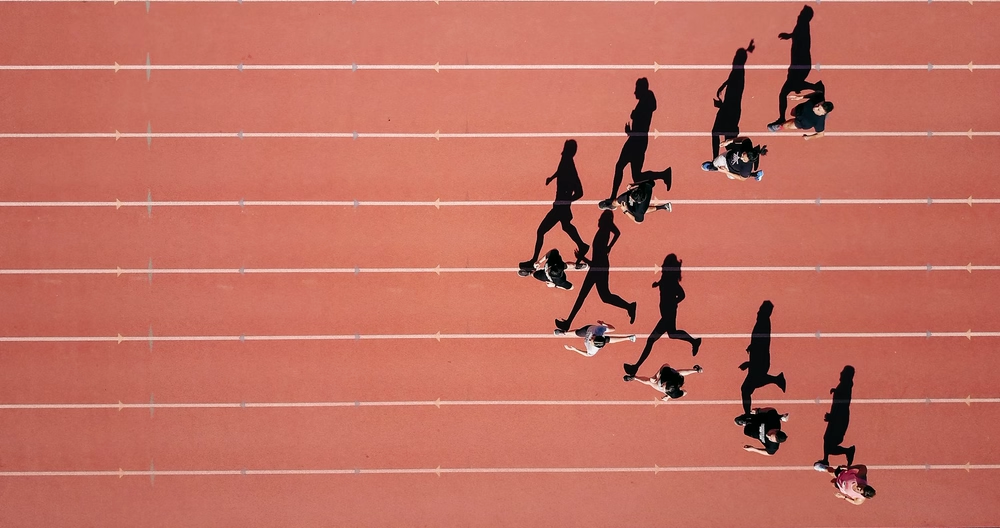
Runners viewed from above on a red athletics track.
In summary

Project overview

The challenge

Create a profitable e-commerce channel for a well-established Paris running shop with no online presence, competing against major retailers already entrenched in the market.

Our work

Structure more than 200 products and 380 variants, produce the content, build the Shopify store and develop first a local, then an editorial, SEO strategy.

The result

The investment paid for itself in under five months, monthly impressions exceeded 56,000 and Google visibility continues to grow by 30% per month on average.

01 — Context

Context

KM42 The Running Store is an independent running shop near Parc Monceau. For more than ten years, it has been a Paris reference for runners seeking expert advice and specialist brands. The business thrived offline but had no online presence. Logiks designed and built its entire e-commerce operation, from the catalogue and photography to the editorial architecture and SEO. The investment paid for itself in under five months, and Google visibility continues to grow by more than 30% per month on average.
02 — Challenge

The challenge

At the foot of Parc Monceau in Paris’s 8th arrondissement, KM42 The Running Store has supported Parisian runners for more than ten years. An independent shop, free from chain targets and margin pressure, KM42 built its reputation on a principle the industry had almost forgotten: listen to the runner before selling the shoe. First runs, marathon preparation, a gradual return to running or an ultra-distance goal—customers visit KM42 to discuss their stride, an ankle problem or a specific objective.

Hoka, New Balance, Saucony, On, Brooks, Garmin and Coros are selected for their performance, not their margin.

In Paris, however, loyalty to a physical shop is no longer enough to secure its commercial future. Online retail now captures 21.9% of the sports and active-lifestyle market (Kantar Worldpanel, 2023), more than 1.6 percentage points above the average for clothing, footwear and accessories. Purchases are made on smartphones, comparisons are settled from the sofa with ChatGPT, and end-of-season promotions are found online before the shop opens.

Competing with the e-commerce giants is a formidable task for an independent retailer (Nike, On, Saucony, Décathlon, Terre de Running, I-Run). These businesses are long established and have advertising budgets on an entirely different scale.

Three structural weaknesses defined the diagnosis.

  • No digital presence.

    Despite being one of Paris’s leading running shops, KM42 had not developed an online business. The reason was understandable: competition in the sector is extreme, and the return on digital investment is far from assured for an independent retailer.

  • A dense, demanding catalogue with no internal structure.

    The range included several hundred products (running and trail shoes, technical clothing, GPS watches, sports nutrition and recovery products), all selected by the owner for their sporting relevance. The team held a wealth of expertise that was not available anywhere online.

  • Margin erosion in purely bricks-and-mortar retail.

    Regular runners shop across multiple channels: in store for advice and fitting, online for repeat purchases, consumables and promotions. Without an e-commerce channel, KM42 inevitably lost part of each customer’s lifetime spend.

The objective was not to create a token online presence or a simple brochure website. It was to build a productive, indexable, durable and profitable e-commerce asset in one of the web’s most competitive sectors, facing giants that are both the shop’s suppliers and its direct online competitors.

03 — Solution

The solution

We designed and developed a complete e-commerce operation across four complementary workstreams. This was not a brochure site attached to a shop, but a self-sustaining commercial channel designed to compete with the sector’s pure players.

  • Stage 1. Architect a demanding catalogue.

    Before any visual or technical work could begin, the foundations had to be laid. More than 200 product pages were created from scratch and deployed across approximately 380 variants (size, colour and model), organised into 28 thematic collections: men’s running, women’s trail, technical clothing, GPS watches, gels and nutrition, recovery and end-of-line products. Every product sits within its family, and every family follows a clear purchasing logic.

    A runner looking for a women’s trail shoe can find it in two clicks; someone searching for an energy gel before a marathon can find that just as quickly. No token catalogue and no loose taxonomy: an architecture designed for conversion.

  • Stage 2. Produce the catalogue’s visual and editorial content.

    In running e-commerce, photography is not decoration; it is part of the sales argument. A shoe is sold not only through its technical specifications, but through its shape, sole and details. We managed visual-content production across the entire catalogue: sourcing manufacturer assets, photographing the shop, retouching, cropping, calibrating colour and creating consistency within a single visual grid.

    More than one thousand images were reviewed before publication. On the editorial side, every page combined the standards of expert sports advice with those of organic search: precise guidance on intended use (distance, terrain, stride and elevation), clear explanations of each model’s strengths, and language aligned with runners’ search queries. Here, a product page is not merely a sales pitch; it serves the customer before purchase.

  • Stage 3. Build Shopify around the business and train the team to operate independently.

    The e-commerce operation was developed on Shopify, a robust platform capable of handling a dense catalogue with many variants without creating technical debt. It includes several hundred structured variants, a multi-option basket and a mobile-optimised purchase journey. The platform alone, however, is not enough: the team must know how to operate it.

    We therefore trained KM42 in three distinct areas: Shopify back-office management (creating product pages, managing inventory and tracking orders), photo editing (preparing visuals to the site’s standards), and editorial writing (product content calibrated for both runners and Google).

    The team does not depend on the agency for every update or need to open a ticket to add a product. Control of the tool remains in-house, where it belongs.

  • Stage 4. Build SEO authority from zero by exploiting the right openings.

    A new website is invisible to Google. To avoid waiting six months for organic rankings before the first sale, we used KM42’s Google Business Profile (owned by the business for more than ten years and supported by hundreds of reviews) as the foundation of its local authority.

    Updates, connection to the new site and signal optimisation turned the profile into the anchor from which SEO and GEO could develop. The first online sales came through this local-search presence, before organic SEO took over.

A second and even more strategic opening remained. On purely commercial queries, KM42 competes against the advertising budgets of global brands—a battle it cannot win directly. Competition also exists for informational queries (Nike, Saucony and Décathlon employ entire content-marketing teams), but the rules have changed.

Under pressure from European regulation (the Digital Markets Act, which entered into application in March 2024) and through the 2024–2025 Core Updates, Google increasingly rewards demonstrated expertise from independent niche specialists while downgrading generic corporate content. That opening, created by both regulation and the algorithm, was the one to pursue.

Three long, highly specialised articles were produced alongside the catalogue launch: “How carbon plates work”, “Gels, bars and purées: what’s the difference?”, and “Why high-tech foams change the way you run”. Each uses a dense, precise and technically informed vocabulary.

Within weeks, the algorithm could recognise a depth of expertise that no product page could have established as quickly. The website gained authority, and the halo effect benefited the entire catalogue. Today, these three articles account for half of all SEO clicks outside the home page. Runners arrive with a question and leave ready to buy.

04 — Impact

The impact

Three results, measured in three different ways.

  • Commercial evidence: the project paid for itself in less than five months.

    The first sales arrived before organic SEO had taken over, captured through the reactivated Google Business Profile. After five months of operation, revenue generated by the digital channel exceeded the entire investment made to build it. For a shop with no online presence six months earlier, the conclusion is clear: a well-built website is not an expense, but a profitable investment.

  • SEO evidence: visibility is growing by more than 30% per month.

    Across the four months measured since launch, Google impressions increased by an average of +30% per month, rising from fewer than 20,000 to more than 56,000 a month. SEO clicks grew at an average rate of +14% per month. The site now attracts more than one thousand organic-search visitors each month, with consistent growth.

  • Competitive evidence: seven highly competitive Paris queries rank between 1st and 5th on Google.

    KM42 now appears among the first five results for the most contested queries in the Paris running market: “magasin running paris”, “boutique running paris”, “saucony paris”, “brooks paris”, “mizuno paris”, “magasin trail paris”, and “running store paris” (average Google Search Console positions, December 2025–May 2026).

    Seven positions have been won from competitors established for ten years and supported by advertising budgets on an entirely different scale.

The art of turning ideas into digital realities

Explore our portfolio and imagine what we could achieve together to take your online presence to new heights.

Your competitors
will be left behind