


SEO is no longer limited to a blue position. The same intention can produce a result page, a local file, a video, a product, an extract, an AI Overview or a conversational response. L-user can obtain a synthesis without clicking, and then return later by the brand.
The audit must therefore distinguish three results: to be found, to be used as a source and to obtain a measurable action.
The base remains familiar. If an engine cannot explore, render, understand or trust a page, add "GEO" to the project does not change anything.
1. Figures that redefine visibility measurement
In May 2026, Google Search Central published a guide dedicated to generative features. Google states that good SEO practices remain fundamental and insists on useful, unique and non-substitutable content. The publication also announces a clarification of AEO/GEO myths: there is no magic tag reserved for AI responses.
Pew Research Center analysed 68,879 Google searches conducted by a panel of 900 American adults in March 2025, collecting results in April. 12,593 sample searches produced AI synthesis, or 18%.
When the synthesis appeared, participants clicked on a traditional result in 8% of visits, compared to 15% without synthesis. They clicked on a source of synthesis in 1% of visits. 26% ended their session after a page with synthesis, compared with 16% without. These figures describe an American panel, a period and a product that is evolving; they should not be transposed as a universal CTR.
Long requests were more associated with syntheses: 8% for one or two expressions, compared with 53% for ten or more words in this study. 60% of requests starting with an interrogative word produced a synthesis. Content that answers complex questions becomes an important field, without removing the short and transactional request.
The speed remains a technical fundamental. Google recommends LCP ≤ 2.5 s, INP ≤ 200 ms and CLS ≤ 0.1 at the 75th percentile for Core Web Vitals. These metrics do not ensure ranking, but an unstable or blocked page reduces the experience, the rawl rendered and the conversion.
2. The five-step visibility model
The audit follows a chain. An upstream defect limits everything that follows.
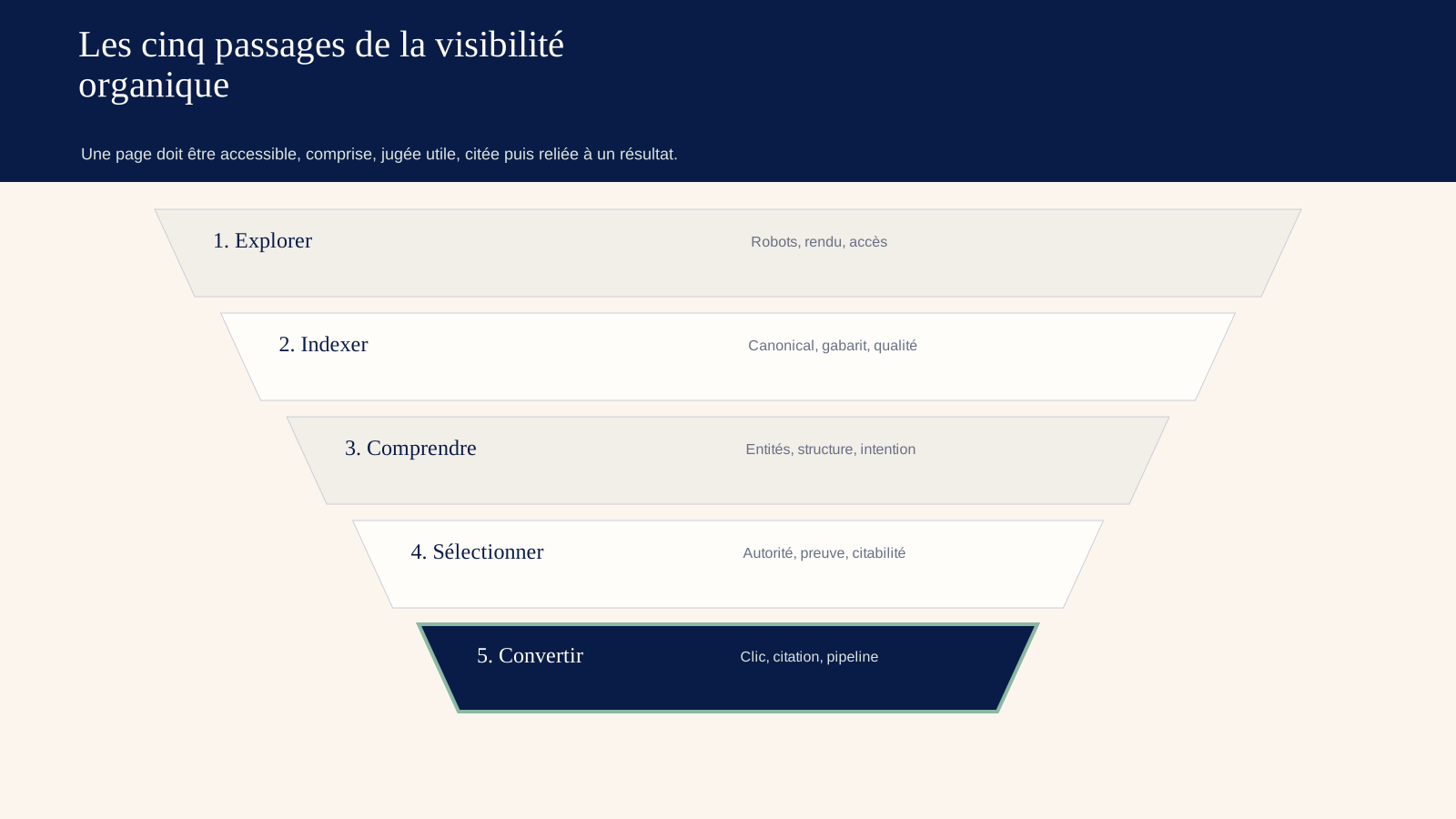
- Accessible. Content can be explored and rendered.
- Indexable. The correct URL can be preserved and canonized.
- Understandable. Subject, entity, offer, evidence and relationships are explicit.
- Selectable. The content deserves to be classified, extracted or quoted.
- Actable. The user can check, contact, buy or memorize.
Being quoted without identifiable brand creates little active. Arriving first without conversion is not necessarily a success. The audit keeps the five separate levels.
3. Phase 1 — Mapping demand, not just keywords
The research begins with public decisions. For each service, the audit identifies: problem, solution, comparison, proof, risk, price, implementation, supplier, locality and brand.
An intention can be formulated in dozens of ways. The clustering brings together requests that await the same page or answer. It does not merge separate topics on the pretext that they share a word.
Sources include Search Console, Internal Search, Business Conversations, Support, CRM, Forums, Keyword Tools, Trends and SERP observed. Third-party volumes are estimates. Search Console impressions are site-specific. Both are labelled.
The audit produces a matrix:
| Intention | Moment | Dominant format | Current page | Variance |
|---|---|---|---|---|
| "cost of web application" | comparison | guide, calculation, case | generic article | no budget scenario |
| "business application agency" | selection | service pages, evidence | indexed page | evidence too weak |
| "How long MVP" | framing | short response + method | Dispersed FAQ | no central source |
This mapping separates catchable demand, demand to create and branded demand.
4. Phase 2 — Explore as search engines do
The crawl collects status, redirections, canonical, robots, noindex, links, depth, hreflang, sitemap, pagination, resources and render. The sample compares HTML initial and DOM rendered for JavaScript sites.
Server logs, when available, show what robots actually ask for. They reveal wastage on filters, errors, old URLs or resources. They do not prove indexing, but supplement the crawler.
The audit shall verify:
- important pages accessible in a few links;
- consistent HTTP codes;
- redirection without chain;
- canonical pointing to an equivalent indexable URL;
- clean and dated sitemaps;
- controlled parameters and facets;
- main content present without impossible interaction;
- resource requirements not blocked;
- Explorable HTML links;
- Excluded test environments.
The depth is not a three click dogma. It indicates the weight given by the architecture. An orphan strategic page is a clear signal.
5. Phase 3 — Diagnose indexing by template
Search Console, Inspections, site: The figures do not always coincide. The audit looks for the reasons.
URLs are classified as useful indexed, unindexed, unindexed, unindexed, duplicated, canonical alternatives, errors, soft 404 and voluntarily excluded pages.
The analysis is done by template and date. If 80% of new pages remain out of index, the cause differs from an isolated page. Low content, insufficient links, wrong canonical, infinite URL generation or rendering may be responsible.
An indexing ratio is not to be maximized. Filters and technical pages must remain excluded. The objective is that URLs that respond to a request have an accessible and quality canonical version.
6. Phase 4 — Audit the information architecture
The architecture connects entities, subjects and offers. Pillars respond to a primary intent, then direct to sub-services, cases, guides and evidence.
The anchors describe the destination. The links are placed where the next decision becomes natural. An automatic block of fifty links dilute the utility.
The audit builds an internal graph. It measures centrality, orphan pages, depth and communities. It compares the technical graph with the business model: do priority services actually receive links and evidence?
Taxonomy avoids empty archives and synonym tags. For a multilingual site, each language has URLs, reciprocal hreflang and adapted content. Unread machine translation can create numerous and unreliable pages.
7. Phase 5 — Assess content as evidence
Each page is analysed on six dimensions.
Adequacy. Does it respond to the intent and level of decision-making?
Originality. Does it bring experience, data, method, example or point of view that cannot be replaced by a generic synthesis?
Accuracy. The facts are hurled, dated and nuanced.
Useful completion. Important objections are covered without filling.
Identity. Author, company, expertise and responsibility are identifiable.
Action. The next step is to check, compare, contact or calculate.
The audit samples pages with high traffic, high potential, decrease, conversion and risk. An automatic score of words does not measure the value.
For YMYL or sensitive topics, the evidence bar goes up. Primary sources, dates, qualified authors and editorial policies become central.
8. Phase 6 — GEO/AEO: test citability without pretending it is an exact science
A generative response can change according to date, context, location, account and formulation. The audit therefore builds a reproducible protocol, not an absolute ranking.
It selects 50 to 200 decision-related questions, distributed by intention and language. For each engine or interface it records date, visible model, response, brands, sources, citation position, sentiment, accuracy and link.
The results are repeated over several days or sessions.
- rate of presence of the mark;
- citation rate of the domain;
- Attribute accuracy;
- share of votes among competitors;
- stability;
- covering strategic issues;
- identifiable reference traffic;
- assisted conversions and brand search.
The citation rate is not a final KPI. A quote on a question without value can inflate the score. Weighting follows the importance of intent.
The audit looks for the characteristics of the cited pages: clear passage, definition, table, source, date, author, valid structured data, reputation and availability. It does not conclude that a factor causes citation from a correlation.
9. Phase 7 — Entities, brand and external consistency
Engines must link the name to an organisation, offers, people, address, profiles and evidence. The audit checks the consistency of names, descriptions, coordinates, logos, official profiles, indications and structured data Organization, LocalBusiness, Product, Service or other eligible types.
Structured data must correspond to the visible content. They do not guarantee rich results or quotations. An error or abuse may make marking ineligible.
External sources are mapped: press, serious directories, partners, opinions, sectoral bases, authors and communities. The aim is not to make mentions. It is to correct inconsistencies and create evidence worthy of reference.
The brand name, product names and leaders must be disambigulated. A weak "About" page complicates this understanding.
10. Phase 8 — Authority and links
Backlink audit assesses relevance, diversity, target pages, anchors, dynamics, unrelated mentions and risks. Gross number of domains is not enough.
A link from a reference organisation to an original study has more strategic value than a hundred generic directories. Link purchase campaigns expose to risks and do not necessarily build a reputation.
Assets that can obtain references are identified: data, tools, studies, methods, glossaries, maps, standards and documented cases. The content strategy must produce something that others wish to cite.
For the AI responses, the statements can count even without any link, but their measurement remains partial. The audit distinguishes what is observed from what is supposed.
11. Phase 9 — On-page technical quality and experience
Titles, headers, meta descriptions, canonicals, images, videos, structured data and mesh are controlled by template. The titles describe the promise and differentiate. The meta description influences the presentation without guaranteeing the ranking.
Core Web Vitals are analysed in field and laboratory. Business pages are grouped by template. A quick page does not compensate for absent content; a slow page can reduce access and action.
The audit checks mobile, keyboard, contrasts, stability, pop-ups and interstitials. The experience is not a single SEO signal. It determines what the user can accomplish.
The images have dimensions, formats, alternative contextual texts and dedicated pages when the intention is visual. The videos have titles, descriptions, miniatures, transcriptions and structure.
12. Phase 10 — Measure beyond traffic
The dashboard contains four levels.
Cover. Explorable URLs, indexed, errors, freshness and orphan pages.
Visibility. impressions, positions, features, AI quotes, local presence and share of demand.
Commitment. clicks, qualified visits, brand search, reading and intermediate actions.
Value. qualified leads, income, margin, assistance, pipeline and acquisition cost.
Search Console and analytics have different scopes. AI syntheses sometimes reduce the click. The reporting therefore preserves the impressions and the branded demand, without claiming to attribute a sale to an unseen citation.
Pages are followed by publication or correction cohorts. Comparison before/after taking into account seasonality and updates. A visibility gain without commercial demand can validate the authority but not the ROI.
13. Audit score
Logiks separates ten scores: demand, crawl, indexing, architecture, content, entities, authority, GEO/AEO, experience and measurement. Each has proof and trust.
A ceiling applies. If the strategic pages are not indexable, the overall score cannot be "performing". If no business source links traffic to leads, the value score remains low even with high positions.
The recommendations follow impact, effort, dependency and time frame of evidence, and are classified as follows:
- blockers, crawl errors, indexing, migration or compliance;
- foundations, architecture, entities, templates, measurement;
- growth, pages, evidence, formats, relationships;
- Experiences, presentation tests and generative questions.
Each action has a witness. "Improving E-E-A-T" becomes "add author, methodology, date, primary sources and editorial manager on the twelve strong-decision guides, then measure indexing, requests and citations over 90 days."
14. Practical case: stable traffic, pipeline declining
A B2B company retains its organic traffic, but qualified leads drop by 25%. The team wants to publish more.
The audit shows that informational pages continue to receive clicks. Service pages have lost internal links after migration and their canonicals sometimes point to a generic version. AI summaries appear more on upstream issues, but this is not the main proven cause.
The CRM also reveals that an old form created an opportunity directly, while the new one stores some leads without a source. The problem combines SEO and measurement.
The canonical restoration correction, meshing and CRM tracking. Three service pages are rebuilt with methods, cases and selection criteria. A set of fifty questions follows quotations and accuracy, but the main KPI remains the qualified pipeline.
The massive publication is suspended. Priority is given to pages that link demand and supply.
15. Deliverables expected
- Map of intentions and opportunities;
- complete crawl and indexing diagnosis;
- internal-link graph and target architecture;
- Inventory of content with decisions keep/merge/rewrite/delete;
- audit entities, structured data and reputation;
- GEO/AEO protocol and question baseline;
- performance analysis and experience;
- reconciliation Search Console, analytics and CRM;
- prioritised backlog with validation criteria;
- Plan 30, 90 and 365 days.
Exports, rules and requests are handed over. The team must be able to repeat the audit after a release.
16. Frequently Asked Questions
16.1. Does GEO replace SEO?
No. Google indicates in 2026 that SEO fundamentals remain the basis of its generative features. Other engines have their systems, but accessibility, useful content, entities and reputation remain structuring.
16.2. Can we guarantee a citation in ChatGPT or Google?
No. Responses vary and ownership mechanisms. Eligibility, proof and measurement can be improved, not an organic guarantee can be purchased.
16.3. How many questions should be tracked?
Start with 50 to 200 questions covering important decisions. Repeat and weigh. Ten prompts selected do not give a reliable baseline.
16.4. Is structured data sufficient?
No. They help to describe content in accordance with the expected formats. They do not replace visible information, authority or indexing and do not guarantee any presentation.
16.5. When will the audit be repeated?
After migration, redesign, fall, domain change or international expansion, then annually. Crawl, indexing, performance and strategic issues are monitored between audits.
17. What the audit must retest before drawing conclusions
The readout separates presence, visibility, traffic and value. A brand can appear in a generative response without quotation, receive a quote without clicks, gain impressions without request and convert thanks to already known requests. Each of these states has a different measure.
The countertest selects priority intentions, multiple formulations and page profiles. It checks indexing, rendering, content, entity, links, sources and results in the engines on a given date. Generating responses are variable, frequency and protocol are retained.
For a fall, the team compares the period, cohorts of pages, seasonality, updates, competition, technical changes and brand demand; it then tests the dominant explanation on a subset, because automatically associate the decline with AI Overviews, a "penalty" or an undocumented change in algorithm produces a quick narrative but rarely a reliable correction priority.
The action plan gives each page an intention, missing evidence, a correction and an indicator. Transversal tasks — canonical, rendered, mesh, structured data or entity governance — have a technical owner.
A cohort measure follows published or corrected pages: coverage, impressions, requests, clicks, observed quotes, leads and quality. Conclusions remain cautious when several changes coincide.
The audit record dates the generative observations and keep requests, language, device, account, displayed sources and necessary screenshots, as a response can vary from one session to another; instead of selling a universal "quotation rate", the team follows a stable protocol, publishes uncertainty and checks whether content improvements also produce more understanding, brand search or qualified applications.
In the next review, the unchanged pages are separated from the pages without indexing, without impressions and without conversion. The recommended action differs: wait, strengthen, consolidate or remove.
Each choice has a date and a condition of review, so that the absence of results never becomes an indefinite expectation.
18. What Logiks recommends
Treat visibility as a chain: accessible, indexable, understandable, selectable, actionable. Measure AI responses with a repeated and weighted protocol, without assigning an imaginary causality to them. Correct foundations, then invest in original evidence and content that both users and engines have a reason to choose.
19. Main sources
- Google Search Central, new resource for generative features, May 15, 2026: https://developers.google.com/search/blog/2026/05/a-new-resource-for-optimizing
- Google Search Central, SEO documentation: https://developers.google.com/search/docs
- Pew Research Center, analysis of 68,879 Google searches: https://www.pewresearch.org/short-reads/2025/07/22/google-users-are-less-likely-to-click-on-links-when-an-ai-summary-appears-in-the-results/
- Google web.dev, Core Web Vitals thresholds: https://web.dev/articles/vitals
- Google Search Console, documentation: https://support.google.com/webmasters/