


A process of 10,000 files can be 90% automated and become more expensive if the remaining 10% concentrates all ambiguities, interrupts teams and generates hard-to-track rework.
The automation rate does not pay the bills; net throughput does.
1. Definition: automation means redesigning the work system
Operations automation uses rules, API, workflow, RPA, predictive models, documentary recognition or agents to run a part of a process with less manual intervention. Its perimeter ranges from deterministic data transfer to adaptive action supported by AI.
A production-grade automation defines an input event, expected state, data, logic, rights, evidence, exceptions, validation and recovery procedure. It has a service manager and targets for quality, timeliness, cost and availability.
Automation therefore does not mean reproducing every existing click. The team first removes the worthless steps, standardizes the useful rules and reorganizes the decision; only then it chooses what deserves machine execution.
2. Key figures: use is increasing, but process transformation still lags
- The France Num Barometer 2025 reports that 26% of responding microbusinesses and SMEs use an AI solution, but only 5% cite task automation, compared to 22% for generative AI. The gap between individual testing and operational transformation remains significant.
- Among the French companies using AI in 2024, INSEE observed that 27% used AI for production or service processes and 24% for administration, the latter proportion having doubled since 2023.
- Eurostat measures 20% of European enterprises with at least ten AI users in 2025; small enterprises are around 17%, 30.36% among medium-sized enterprises and 55.03% among large enterprises.
- The French e-invoicing reform concerns more than 10 million economic actors: mandatory receipt on 1 September 2026 for all enterprises, mandatory issuing on that date for large companies and mid-sized companies, and 1 September 2027 for SMEs and micro-enterprises. Four new mandatory fields illustrate the importance of structured and controlled data.
- In the NBER study of 5,179 support agents, an AI assistant increased the number of cases resolved per hour by an average of 14%, but the effect was 34% for novices. An average automation result therefore hides differences in population and task.
- NIST reports, on indirect injection assays, that the average success of five attacks increased from 57% on an attempt to 80% after 25 attempts. Giving tools and permissions to an agent requires stronger controls than just a chatbot.
The conclusion is practical: select by process, measure on the complete result and adapt autonomy to risk.
3. Map 1 — Decompose the process into automated units
Take a real workflow from trigger to completion. A supplier application, for example, may include receipt, identity check, extraction, reconciliation, approval, order, payment, archiving and dispute handling.
3.1. Identify process states
Each file is in an explicit state: received, incomplete, validated, pending, approved, rejected, executed or cancelled. Transitions indicate conditions, actor, data and time stamping.
This state machine prevents a "successful" automation from sending an email while losing the case file between two tools. It also makes the process observable: waiting time, blocked volumes and rework loops become measurable.
3.2. Classify the nature of each step
- Deterministic: stable rule, certain output, simple control.
- Probabilistic: ranking, extraction or forecasting with variable confidence.
- Discretionary: contextualized judgment, arbitration or relationship.
- Committing: payment, contractual change, access or external communication.
A step may belong to two classes. Extracting an amount is probabilistic; triggering its payment is engaging. Separating them enables automatic extraction with validation without giving immediate financial power.
3.3. Remove before automating
Question each field, approval and transfer. A double entry imposed by unconnected systems deserves an API; an approval that is always granted below €1,000 € may deserve a new rule; a report never read must disappear.
The first gain often comes from simplification. It remains valid even if the AI project is then abandoned.
4. Map 2 — Assess potential through volume, variability and consequences
A three-axis matrix places each unit.
4.1. Volume and load
Measure monthly folders, active duration, waiting, seasonality and backlog. The length of time declared by a workshop is insufficient: sample the work, distinguish between processing time and end-to-end time, and then include rework.
4.2. Variability and data
Count formats, languages, sources, exceptions, local rules and changes. A process that seems stable can be based on the memory of two people; documenting exceptions reveals true complexity.
Evaluate data quality, completeness, access and freshness. An agent does not permanently compensate for inconsistent supplier codes, files without identification or conflicting rules.
4.3. Consequence of error
Quantify losses, delays, non-compliance, harm to a person, risk of fraud and difficulty of recovery. An error detected before sending is not worth an undue payment or an account closure.
Logiks recommends a first selection in the high volume area, controllable variability, verifiable output and reversible error. Critical cases become available after evidence and controls are built.
The best candidate is not always the most visible.
5. Map 3 — Choose the right automation family
5.1. Workflow and API
For known rules and accessible systems, workflow and API offer the best traceability. They validate schemas, call applications and keep explicit statements.
5.2. RPA
Robotic process automation helps when an old application does not offer an API. It accelerates a transition, but remains sensitive to changes in screens, windows and sessions; its maintenance cost must be compared to sustainable integration.
5.3. Predictive model or recognition
Classification, anomaly, scoring, forecasting, extraction and vision handle variability that rules alone cover poorly. Their output carries a score or uncertainty that must influence the workflow.
5.4. generative AI and RAG
They suit summarisation, writing, retrieval and transformation of unstructured content. A plausible output is not necessarily accurate; sources, formats, validations and abstention are part of the product.
5.5. Tool-using agents
An agent plans several steps and uses tools. Reserve it to situations where the sequence actually varies and deterministic orchestration becomes disproportionate. Give the agent its own identity, minimum permissions, budget, limits on actions and validation before committing acts.
Choosing more autonomy than necessary increases the cost of proof. It's rarely an advantage.
6. Map 4 — Design the exception-handling ladder
The exception is not a residual failure. It is a product to be designed with as much care as the automated path.
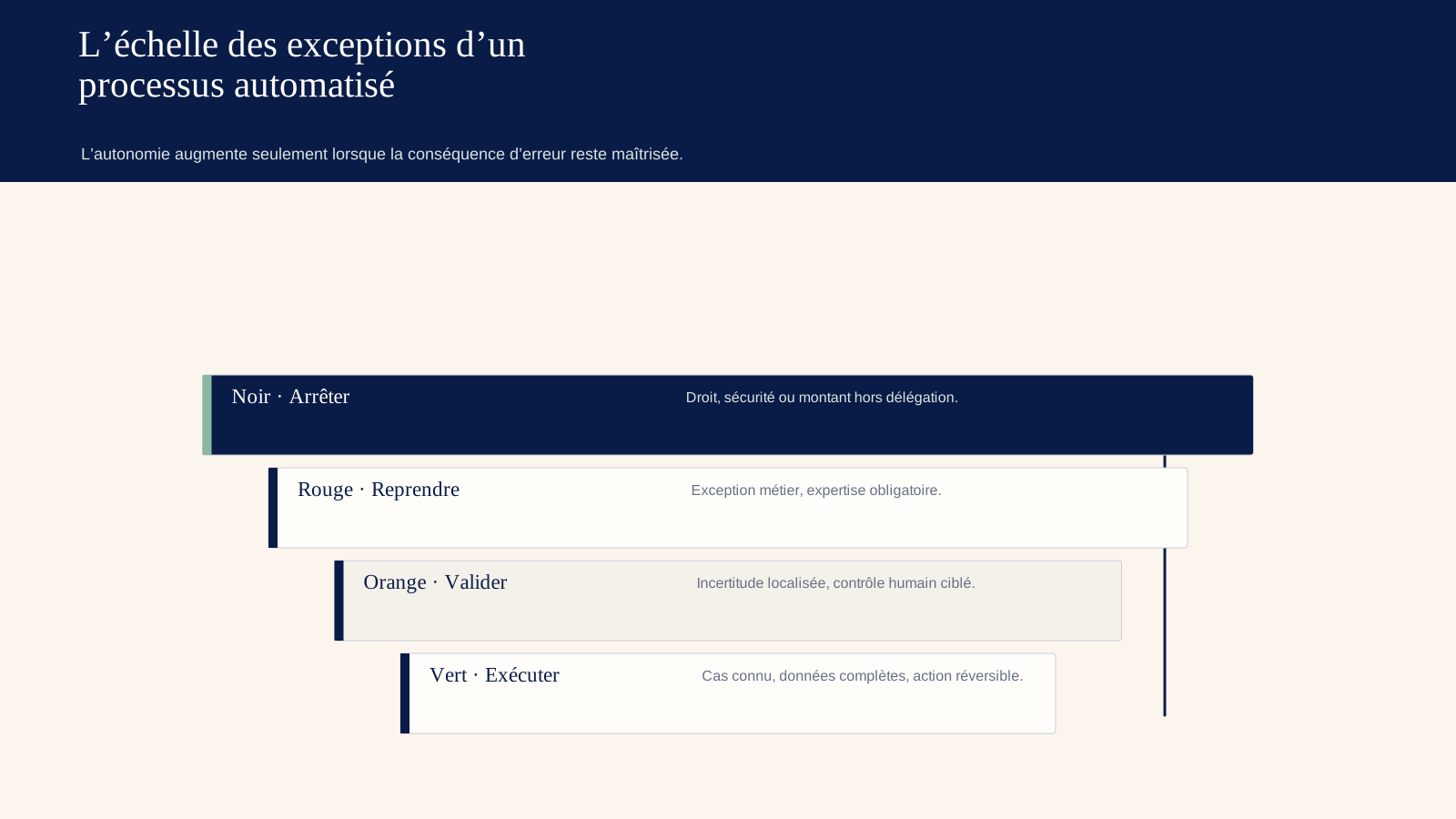
6.1. Green level — Automatic execution
The data are complete, the rules stable, confidence above the threshold, and the action is reversible. The system executes, logs and submits samples for audit.
6.2. Orange level — Targeted validation
An ambiguity, a high amount or a new case triggers a review. The interface shows source, proposed value, reason for the flag and options; it does not require humans to rebuild the entire file.
6.3. Red level — Expert recovery
The case involves fraud, security, vulnerable person, complex contract or conflict of rules. Automation prepares the information and then hands it to an authorised role, without silent decision.
6.4. Black level — Controlled stop
A malfunction, drift, attack or systemic inconsistency freezes execution, preserves case files and switches to a fallback mode. The runbook specifies trigger, authority, communication, restoration and reconciliation.
The threshold is not based solely on model confidence. It combines trust, amount, type of customer, novelty, data quality and consequence.
7. Map 5 — Calculate net ROI per case
The calculation starts from the full flow.
Monthly net gain = (avoided current cost + realised capacity + avoided errors) − (licences + compute + review + maintenance + support + incidents + change).
7.1. Quantified example
A team processes 20,000 monthly files in four minutes, at a loaded hourly cost of €35. The theoretical direct cost is 46,667 €. The system automates 70%, reduces assisted files to two minutes and sends 10% of the total to a six-minute review.
- Automated: 14,000 files, almost zero human time but sample control;
- assisted: 4,000 × 2 minutes = 133 hours;
- reviewed: 2,000 × 6 minutes = 200 hours;
- Total: 333 hours, or about 11,655 € direct labour.
The gross saving appears to be close to €35,000. Withdraw €8,000 from licences and infrastructure, €6,000 from maintenance and data, €4,000 from support/training, and then €3,000 from errors and recoveries: the net gain is €14,000 if the capacity is actually used.
Add amortization of €180,000 for integration. At €14,000 per month, the simple payback period exceeds twelve months; a decrease in volume, an increase in the exception rate or a change in application can lengthen.
7.2. Value quality and timeliness
Closing two days earlier may reduce the need for cash flow or improve satisfaction. Duplicate detection avoids loss. Document the formula and avoid counting twice the same effect in time and income.
Profitable must remain verifiable.
8. Map 6 — Build pre-scaling controls
8.1. Entry checks
Diagram, identity, duplicate, format, virus, consent, rights and provenance. Unreliable data is rejected or quarantined.
8.2. Processing checks
Rule or model version, rate limits, role separation, budget, ID and sandbox. A restart must not pay twice or send three messages.
8.3. Output controls
Format, total, consistency, authorised list, references, amount and human validation based on risk. The output of a model remains an unreliable input for the next system as long as it has not been controlled.
8.4. Monitoring
Automatic rate, exceptions, false positive/negative, drift, cost, latency, availability and variance per segment. Thresholds trigger investigation, reduction of autonomy or rollback.
8.5. Accountability controls
Appropriately immutable log, owner, approver, access, retention, notification and remedy. The team must be able to reconstitute the decision without unnecessarily exposing the data.
For agents, add defences against indirect injection, tool validation, dedicated identity and destination restrictions. NIST stresses that traditional cyber principles remain relevant, but must be adapted to the specific threats of agents.
9. From pilot to service: four production gates
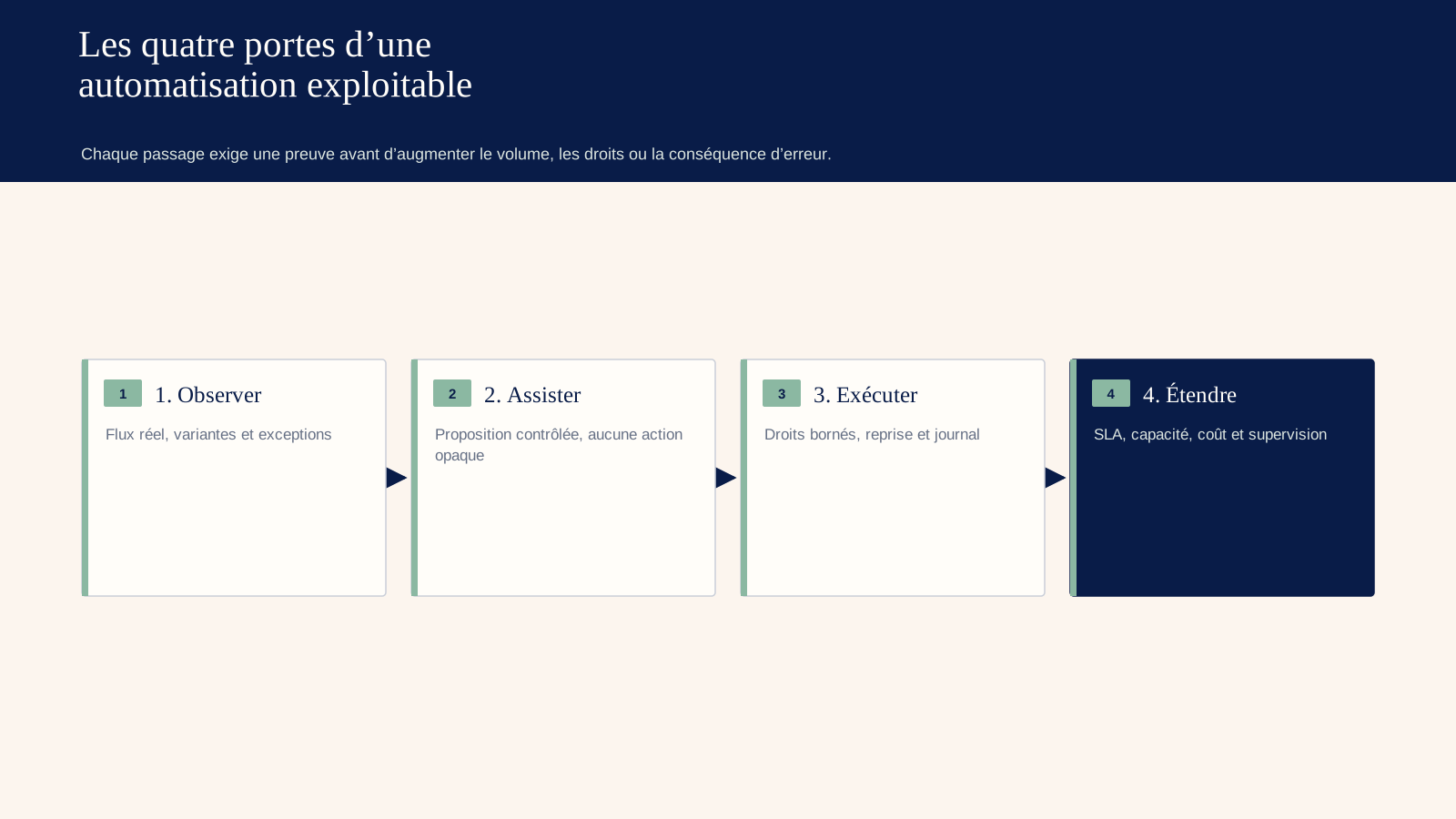
9.1. Gate 1 — Functional accuracy
The system succeeds on a representative dataset, including exceptions, failures and degraded data. Thresholds are calculated by risk class.
9.2. Gate 2 — Observed economics
Full time, recovery, review cost, infrastructure and capacity destination are measured. The ROI no longer comes from a supplier demonstration.
9.3. Gate 3 — Operability
Monitoring, alerts, support, fallback mode, ID, recovery, capacity and dependency changes have been tested. An on-call person knows what to do.
9.4. Gate 4 — Governance
Purpose, data, permissions, security, law, documentation, ownership and review are approved at the appropriate level. The service has a requalification date.
10. Supplier onboarding: workflow, rules and recovery end to end
A company receives 6,000 requests for supplier creation or modification per year. The average lead time is eleven days, while active processing is only forty-five minutes: the case file waits in four mailboxes, returns twice to the applicant and has no common identifier between procurement, compliance and finance.
10.1. Initial state — Waiting costs more than data entry
The teams spontaneously attribute the delay to verification of IBAN. The observation shows, however, that 58% of the calendar time is prior to the assignment to the right controller, 24% waiting for a document and only 8% in the active controls; the rest corresponds to the final rework and approvals.
Automating extraction alone might save ten minutes per file, or 1,000 hours per year, but would leave the queues that cause most of the delay intact. The redesign therefore begins with a single form, an identifier, conditional document requests and a state machine visible to everyone.
10.2. Target journey — Deterministic first
The form validates format, country, type of entity and presence of required documents. An API verifies the existence of the supplier, while reference lists control codes and duplicates; a model then extracts the fields of unstructured documents, but never decides on legal validity alone.
Complete low-risk files are automatically assigned. A change from IBAN, an entity within a defined area, a name conflict or high expected amount passes into orange; an instruction found in an attachment cannot change workflow, because the document's contents remain data and not an order addressed to the agent.
Creation in the ERP requires human approval and uses a dedicated technical identity, limited to this type of object. The service retains the request identifier so that a recovery after timeout first checks if the action already exists: an idempotency safeguard against duplicate creation.
10.3. Recovery — Preserve the case before correcting it
If the ERP becomes unavailable, validated applications pass in a persistent queue without being marked as created. After restoration, a reconciliation compares the case file, log and ERP records before any retry; no person should choose between losing action and replaying it blindly.
When a model changes, ten percent of files are temporarily double-read and reference cases are replayed. A drift on countries, formats or amounts automatically reduces the green-path scope, while the manager decides on a rollback or a new annotation.
10.4. Economics — Measure time, quality and the exception workload
The project aims to achieve three results: a median delay within three days, less than 5% returns for expected parts and a 40% decrease in active time. It also monitors false duplicates, wrong creations, orange/red load, incidents of permissions and satisfaction of internal requesters.
After three months, 62% of files follow the green path, 31% require targeted validation and 7% require expert handling. The median delay is 2.6 days, but active time drops by only 32% because the orange cases are longer than expected; the team does not hide this gap and improves the review interface before opening up more.
The programme is a conditional success. It reduced the wait and made the exceptions visible, but its next investment is on the quality of the documents and the review, not on additional autonomy.
The figures in this example are illustrative. The method, for its part, is verified in the traces of the process.
Production begins after the four gates. Not after the nice demo.
11. Logiks sixteen-week roadmap
11.1. Weeks 1 to 3 — Observe and simplify
Map states, volumes, times, exceptions, costs and data. Remove unnecessary steps. Choose a limited unit.
11.2. Weeks 4 to 6 — Instrument the current workflow
Create identifiers, logs, taxonomy of errors and baseline. Set up the evaluation dataset with the operators.
11.3. Weeks 7 to 10 — Build the main path and exception handling
Automate the green case, design the orange/red/black levels, integrate the controls and test recovery.
11.4. Weeks 11 to 13 — Run a parallel pilot
Compare old and new flows, reconcile outputs, measure economics and user experience. Correct weak segments.
11.5. Weeks 14 to 16 — Open up gradually
Increase volume in stages, monitor the review load and activate runbooks. Decide whether net value justifies scaling.
This roadmap is a Logiks frame. A payment, regulated process or critical infrastructure requires additional validations and durations.
12. Logiks recommendations: eleven signs of an overengineered system
- The robot reproduces steps that no one justifies.
- The automation rate is the only KPI.
- All exceptions arrive in an inbox.
- An administrator account is shared with the agents.
- A retry can duplicate the action.
- Reviewers approve without seeing the source.
- The review cost is missing from the ROI.
- The pilot was unaware of peak periods.
- No failure was simulated.
- A screen change breaks the service without warning.
- No one owns the process after the project.
Operational elegance can be seen in the exception.
13. FAQ
13.1. Which process should you automate first?
A frequent, measurable, sufficiently standard flow, with accessible data, verifiable output, business sponsor and reversible errors. The net value must be plausible before the build.
13.2. RPA, API or agent AI?
API/workflow for accessible rules and systems; RPA as interface bridge; model for variability; agent when the sequence must actually adapt. Use the minimum level of autonomy.
13.3. What automation rate should you target?
The one that minimizes the total cost under the expected quality and risk. 70% robust with good exception handling can surpass 95% fragile.
13.4. How should you manage exceptions?
Classify them, move them to the right role, show context, measure their cost, and use corrections to improve rule, data, or model.
13.5. How can you demonstrate ROI?
Compare baseline and full flow: time, wait, quality, recovery, capacity, losses, licences, infrastructure, maintenance, support and change. Track several cycles.
13.6. Does automation eliminate jobs?
First, it transforms tasks and flows; the effect on jobs depends on the reallocation, demand, skills and choices of the company. Dialogue and training must precede scaling.
14. Conclusion
Good automation does not seek to remove humans from the process. It places rules, models and people where each brings the best control.
Decompose the states. Remove the useless. Choose the minimum autonomy. Design the exception. Calculate the net flow. Test the recovery before increasing the volume.
The result must hold up in real operations.
15. Main sources
- France Num / DGE, France Num Barometer 2025, updated April 7, 2026: https://www.francenum.gouv.fr/guides-et-conseils/strategie-numerique/comprendre-le-numerique/barometre-france-num-2025-le
- Insee, Artificial Intelligence in Enterprises, 14 October 2025: https://www.insee.fr/fr/statistiques/8616837
- Eurostat, 20% of EU enterprises use AI technologies, 11 December 2025: https://ec.europa.eu/eurostat/web/products-eurostat-news/w/ddn-20251211-2
- Ministry of Economy, Any information on electronic invoicing, accessed in July 2026: https://www.economie.gouv.fr/tout-savoir-sur-la-facturation-electronique-pour-les-entreprises
- Brynjolfsson, Li and Raymond, Generative AI at Work, NBER Working Paper 31161: https://www.nber.org/papers/w31161
- NIST CAISI, Strengthening AI Agent Hijacking Evaluations, updated on December 19, 2025: https://www.nist.gov/news-events/news/2025/01/technical-blog-strengthening-ai-agent-hijacking-evaluations
- NIST, Security Considerations for AI Agents, NIST AI 800-5, May 2026: https://www.nist.gov/publications/summary-analysis-responses-request-information-regarding-security-considerations-ai