


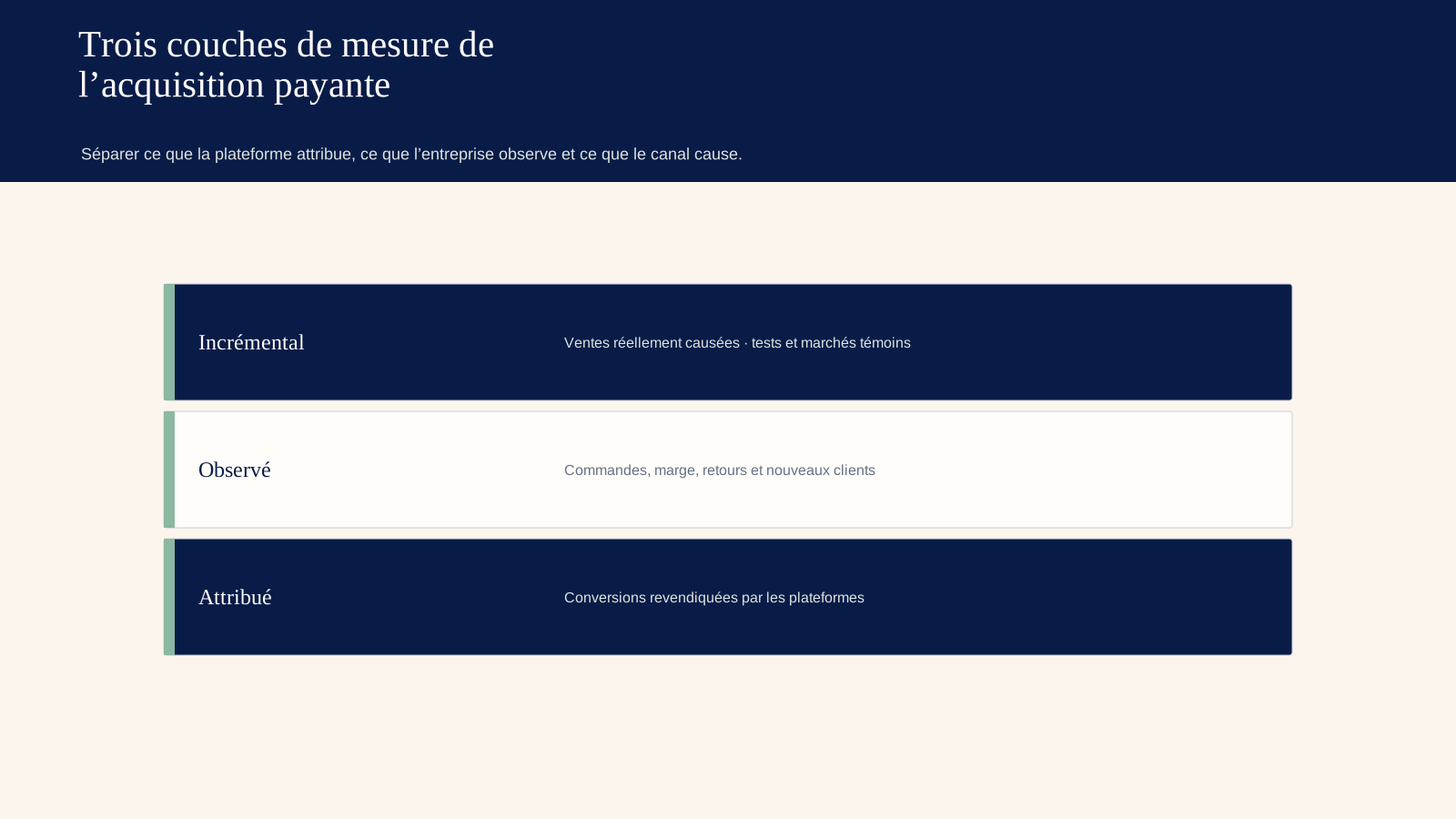
One platform announces a ROAS of 6. Another claims a portion of the same sales. Total turnover increased only 8%. The three findings can coexist because the allocation distributes credit, while Incrementality seeks out what would not have happened without advertising.
The independent audit therefore does not start with the keywords. It starts with the economic result, ownership of assets and conflicts of interest.
Its role is sometimes to confirm the device. Sometimes to correct. Sometimes to recommend a test before any conclusion. Independence does not mean looking for a fault; it means being able to conclude without selling the future management.
1. Figures that require separation of attribution and evidence
Google Research describes geo-experiences as a method of providing the rigour of a randomised test to measure advertising efficiency. The research over multiple periods shows that by running test and control between regions, it is possible to obtain periodic measurements and closer intervals, or a comparable accuracy with a smaller variation in budget.
Another Google paper on the correction of the paid-search bias recalls that marketing mix models suffer from fundamental challenges: collection, specification and selection bias related to targeting. A person who is already looking for the brand is more likely to see and click an ad. The attribution can credit advertising for a pre-existing intention.
The experiments are not a statistical detail. At a summit of 34 experts from thirteen companies — Airbnb, Amazon, Booking.com, Google, LinkedIn, Microsoft, Netflix and others — the organisations represented had tested over 100,000 treatments in one year. The published findings indicated that about one third of the ideas significantly improved metrics and that one third degraded them.
The advertising measure also depends on consent. Google indicates that, as of June 15, 2026, Consent Mode side Google Ads exclusively controls the collection of cookies and Ads identifiers from Analytics tags on related properties. The exact configuration can change the observed and modelled.
In 2025, CNIL imposed fines of 325 million euros against Google and 150 million against Shein, notably for errors related to trackers. The media audit must therefore include the collection path and the choices, not just campaign reports.
2. What distinguishes the independent audit from the operational audit
The operational audit looks at how to improve campaigns: structure, keywords, audiences, bids, creative assets, landing pages and budgets. The team that manages the accounts can do so.
The independent audit adds four questions.
- Are the data and accounts used to verify results without the manager?
- Does the compensation model influence the recommendation to spend?
- Does the platform measure credit or a sufficiently established causality?
- Does the allocation serve the margin and strategy, even if it reduces the fee or media volume?
To preserve this independence, scope and remuneration are agreed before access is granted. The auditor discloses any links with partner agencies, ad networks, software vendors and programmes. Their fee is not calculated as a percentage of the budget they recommend.
The auditor may then accompany the corrections, provided that this phase is separate and the report does not depend on its sale.
3. Engagement letter: protect independence
The letter states:
- expected decision of the sponsor;
- period and entities;
- channels, countries, accounts and partners;
- economic benchmark metrics;
- read access and data requirements;
- exclusions and limitations;
- permitted testing methods;
- declared conflicts;
- owners of the contradictory response;
- reporting format;
- possible separation with implementation.
The sponsor authorizes the consultation of finance, CRM and contracts. An audit limited to advertising interfaces cannot conclude on total profitability.
The period covers seasonality and conversion time. For a B2B cycle of six months, analysing thirty days produces an incomplete vision.
4. Block 1 — Ownership, access and the contractual chain
The audit verifies that the company controls: ad accounts, billing, domains, pixels, audiences, creative assets, history, tag manager, analytics, product streams and admin profiles.
Agency fees must be revocable without losing the account. Personal emails and shared accounts are replaced. Change history is enabled. Inactive accounts are removed.
Contracts are reviewed on:
- fixed fees, percentage of the fee, bonuses and minimums;
- debate, media credits and commissions;
- ownership of creative assets and data;
- subcontractors;
- notice and reversibility;
- responsibility for tracking;
- objectives and method of calculation;
- expenditure incurred without validation;
- margins on programmatic purchases;
- transparency of inventories and costs.
A percentage of the budget is not automatically inappropriate, but it creates an economic interest in increasing the dependency. The committee must know it and add safeguards of margin and incrementality.
5. Block 2 — Reconcile commercial performance
The audit starts with finance: revenue billed or collected, refunds, margin, variable costs and payback period. It builds a bridge to the platforms.
For each channel:
- Invoice against interface expenditure;
- observed conversions;
- attributed conversions;
- CRM/ERP confirmed sales;
- cancellations and refunds;
- new real customers;
- margin and contribution;
- part modelled or imported.
Windows, currencies, spindles, taxes and models are documented. Cross-platform duplicates are quantified where possible.
Platform ROAS is not deleted. It becomes an operational indicator. Instead, the committee receives net contribution, cost per new customer, payback period and experimental results.
In B2B, the audit links leads, qualification, opportunities, signed business and margin. A campaign with a low CPL can still produce prospects the sales team never accepts.
6. Block 3 — Examine concentration and captured demand
Brand campaigns often capture an existing intention. They can protect a space, control the message or support an offer. Their incremental value must be tested, not assumed null or total.
The audit measures:
- share of the budget on the brand;
- real competition for these queries;
- organic overlap;
- variation by geography and device;
- new versus existing customers;
- navigational, commercial and generic queries;
- effect of a controlled reduction.
The same logic applies to retargeting. A user who returns to buy can receive an impression and be credited. We compare windows, customer exclusions, frequency and holdout.
The concentration per platform is assessed. If 75% of the pipeline depends on a channel, a price increase or a policy change becomes a strategic risk. Alternatives are tested on a small scale with a clear criterion.
7. Block 4 — Audit measurement and consent
The auditor follows a conversion from click and landing page through consent choice, event, server import, CRM and reporting. They test acceptance, refusal, withdrawal, cross-domain journeys, mobile flows, duplicates and refunds.
The data is labelled as observed, attributed or modelled. Google's Consent mode can model conversions when thresholds are reached. These estimates are useful and should not be presented as individual transactions observed.
Improved conversions, offline and server-side are examined according to purpose, base, minimisation, hash, transfer and duration. The server-side does not bypass the user choice.
The total income comes from the business system. Platforms receive the necessary and authorised events, with deduplication identifiers.
Tracking deviations become a range of uncertainty in the report. The lack of accurate visibility does not allow an artificially accurate figure.
8. Block 5 — Test incrementality
The test plan depends on the channel.
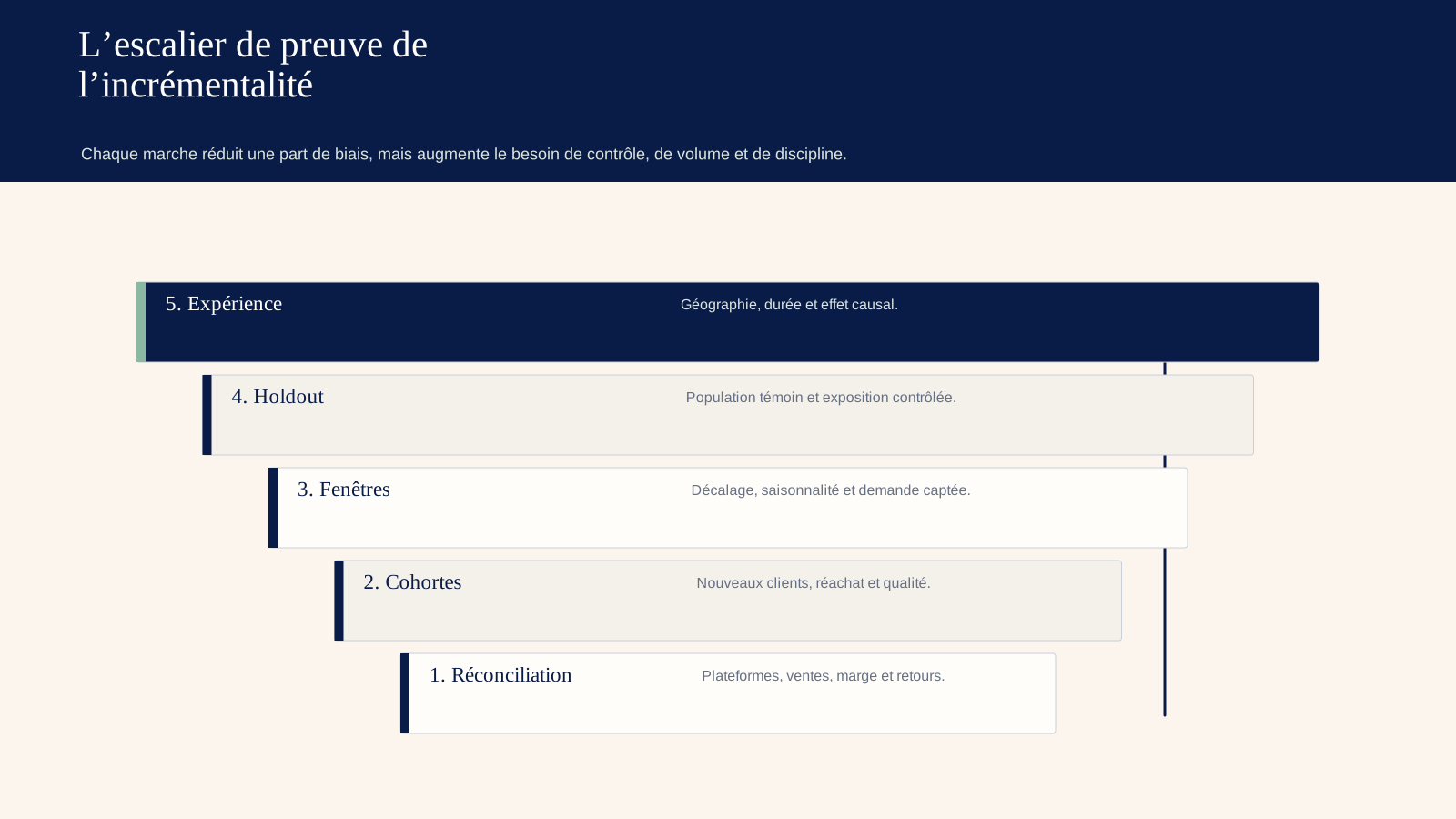
Holdout user. An eligible population is randomised between possible exposure and control, if the platform allows it. Contamination and treatment compliance are monitored.
Geo-experience. Comparable areas receive a variation in budget. The model estimates the difference by controlling trends. Regions must have enough volume and little overflow.
Time switchback. The intervention alternates by windows when geography is impossible, with attention to seasonality and postponement.
Brand test. Certain zones or periods reduce the brand campaign, with safeguards of competition and income.
Creative experience. Variants are randomised; it measures a creation, not the existence of the entire channel.
The protocol is written before reading: hypothesis, unity, duration, minimum effect, metric, safeguards, exclusions and decision. Test until obtaining a positive result invalid inference.
The results include absolute effect, interval and cost. A 10% lift with a range of –5 to +25% remains uncertain.
9. Block 6 — Challenge the budget model
The allocation follows the marginal yield, not the average ROAS. The first conversions of a channel can be profitable; the last much less.
For each channel, the audit estimates a curve: budget, incremental volume, marginal cost, capacity and saturation. It uses experiences, history and documented assumptions.
The maximum allowable margin sets a ceiling. Example: basket 120 €, gross margin 60 €, variable costs 15 €, risk of reimbursement 5 €. The contribution before acquisition is 40 €. A CPA of 35 € leaves 5 €, before fixed fees and future value. If the "target ROAS" ignores these elements, it is not economical.
The cohorts of new clients are followed at 30, 90 and 180 days. The LTV includes retention, margin and cost of service, not only income.
The model reserves a part to learning. An experience has a budget, a horizon and a kill criterion. It is not kept indefinitely as a "test".
10. Block 7 — Review campaigns and creative assets without confusing responsibilities
The independent audit still performs an operational screening: structure, exclusions, search queries, audiences, frequency, bids, placements and feeds, quality of assets, fatigue and landing pages.
It looks for defects that distort economic diagnosis. Examples: secondary conversion used to bid, campaigns mixing brand and generic, fixed value import, client audience not excluded, geographic targeting in presence rather than localization.
Creative assets are evaluated against a hypothesis: problem, evidence, offer, format and segment. The audit compares production of variants with real learning. Fifty similar creative assets do not constitute fifty tests.
The manager has a right of reply, the context of which may explain a decision, and the report distinguishes between interpretation and recommendation.
11. Block 8 — Detect governance bias
The signals to be examined include:
- objective defined by the platform that measures it;
- bonus linked to spend without margin threshold;
- recommendations for increase without marginal curve;
- major changes without testing;
- reporting excluding refunds;
- lack of customer access to accounts;
- creative and non-exportable audiences;
- results shown only in percentages;
- comparison periods chosen after the fact;
- audit sold by the same actor as proof of its management.
A bias does not prove a fault. It requires a compensatory measure: approval, external metric, test, ceiling or independent review.
12. Assurance score
Rather than a "account quality" score, Logiks evaluates seven assurance dimensions.
- Property and reversibility. The company keeps its assets.
- Financial integrity. Spending and results are getting closer.
- Measurement quality. The status of the data is explicit.
- Causality. Tests calibrate attribution.
- Economy. Budgets follow margin and marginal return.
- Governance. Incentives and decisions are transparent.
- Implementation. The fundamentals of accounts do not destroy value.
Each assurance dimension receives a level of proof: strong, medium, low. The overall score is capped if the company does not have the accounts or if the income is not reconciled.
13. Case study: the channel with a ROAS of 8 that could not scale
A brand spends 40% of its budget on brand search. The platform announces a ROAS of 8. The agency recommends +30% budget.
The audit found that 82% of conversions are existing customers or searches containing the brand. A geographical test reduces the campaign in comparable areas. The total income only decreases slightly, but competition recovers a small share on mobile.
The decision is not to stop. The brand budget is reduced and protected on competitive segments. The economy finances a generic test and an improvement of landing page.
Platform ROAS is falling because the mix is becoming more forward-looking. The share of new customers and the incremental contribution is increasing. A reporting focused solely on ROAS would have presented this improvement as a degradation.
14. Deliverables expected
- independence letter and declared conflicts;
- map of accounts, rights, contracts and assets;
- reconciliation expenses–platforms– CRM–finance;
- Observed/attributed/modelled analysis;
- Assurance score by dimension;
- Incrementality tests proposed or analysed;
- Budget curves and scenarios;
- risks of concentration and reversibility;
- priority operational backlog;
- recommended decisions, assumptions and thresholds.
The report includes the limits. If no causal test exists, it does not claim to calculate the exact Incrementality from the historical alone.
15. Correction plan in 90 days
Days 1 to 15. Secure accounts, access, invoices, conversions and property. Correct critical errors.
Days 16 to 30. Reconcil CRM/finance, separate brand/prospect, document templates and consent.
Days 31 to 60. Launch an incremental test, adjust the objectives to the margin and install the cohort reporting.
Days 61 to 90. Reallocate according to initial evidence, test the concentration and review contracts/incentives.
The 90-day review is separate from the weekly pilotage and ensures that the recommendations have not been transformed into new untested assumptions.
16. Frequently Asked Questions
16.1. Will the audit necessarily criticise the agency?
No. It can confirm management and identify limitations of shared data or governance. Right of reply and separation made/interpretations protect fairness.
16.2. Can it calculate true incremental ROAS?
Only if the design and data allow. Without experience, it provides an estimate with assumptions and recommends a test. The displayed accuracy must follow the evidence.
16.3. Who should provide access?
The company owns the accounts and grants the auditor read access. Finance, CRM, analytics, tag manager, contracts and media accounts are required. The data are minimised.
16.4. What frequency?
An annual independent review, or after change of agency, sharp budget increase, measurement migration or degradation. Internal tests and controls work more often.
16.5. Why not entrust the audit directly to the future campaign manager?
It can carry out a useful operational audit. For independent assurance, separate the mission or require declaration of incentives, fixed remuneration and possibility to choose another performer.
17. Which test can connect brand, margin and incrementality?
The report chooses the method according to the likelihood of confusion. A branded-search campaign already captured organically cannot be assessed like prospecting on a new area. Platform ROAS remains an operational indicator, never an automatic estimate of causality.
For each major budget item, the auditor documents the attributed result, CRM result, contribution margin and available incremental evidence. The difference is not solved by an average. It can come from windows, devices, refunds, modelled conversions, offline sales or customers already acquired.
An experiment has hypothesis, unit of assignment, duration, target power, risk of contamination, main metric and safeguards. When the volume does not allow an individual A/B test, the team can use geographies, periods or steps, while setting their limits.
Before recommending an increase of 30%, the analysis must show where the additional expenditure will be placed, how saturation has been estimated, what margin finances the acquisition, what payback period is acceptable, what part of the result depends on an existing demand and what signal the increase will be slowed down; without these elements, "scaling" amounts to prolonging a historical average in an area where bids, audience and quality change precisely because the budget increases.
The closing does not depend on the audited agency. Accounts, audiences, histories, tags, creative assets and access rights can be handed over. Recommendations indicate whether the delivery partner can be put out to tender and whether a conflict of incentive remains.
The committee then follows incremental margin, new customers, saturation, CRM quality and refunds. A campaign that reaches CPA but degrades the customer mix remains open.
The final transfer includes a matrix of rights, exports, naming agreements, experiment history, necessary audiences, exclusions, creative sources and journal of changes, then a person who did not conduct the audit checks that she can reproduce the main figures and resume a campaign without depending on a personal account or oral explanation; independence thus becomes an operational property and not just a statement in the mission letter.
At six weeks, the review compares spending, margin, client mix, saturation, and measurement gaps. An abandoned recommendation has a documented reason and an owner.
Temporary access is removed, sensitive exports are retained over a defined period of time, and computational assumptions are passed on to finance. The mission ends with an organisation capable of challenging, replicating and extending the diagnosis without hidden dependency.
18. What Logiks recommends
First secure account ownership and reconcile income. Separate attribution, modelling and incrementality. Then challenge allocation with margin, marginal curves and pre-written tests. Independence is conceived in contract and metrics, not in a declaration of intent.
19. Main sources
- Google Research, Periodic Measurement of Advertising Effectiveness Using Multiple-Test-Period Geo Experiments : https://research.google/pubs/periodic-measurement-of-advertising-effectiveness-using-multiple-test-period-geo-experiments/
- Google Research, Bias Correction for Paid Search in Media Mix Modelling : https://research.google/pubs/bias-correction-for-paid-search-in-media-mix-modeling/
- Google Research, Methods for Measuring Brand Lift of Online Ads : https://research.google/pubs/methods-for-measuring-brand-lift-of-online-ads/
- Microsoft Research, the top of online experimentation: https://www.microsoft.com/en-us/research/publication/top-challenges-from-the-first-practical-online-controlled-experiments-summit/
- Google Analytics, data checks from June 15, 2026: https://support.google.com/analytics/answer/17016975?hl=en
- CNIL, Google and Shein tracer sanctions: https://cnil.fr/fr/regulation-des-cookies-la-cnil-poursuit-le-plan-daction-initie-en-2019-et-prononce-deux-amendes