


"Doing AI" is not a strategy. The automation of twenty non-priority tasks is no more so. A company progresses when it knows what decision to improve, what evidence to demand, what risk to accept and what capacity to build for the next case.
The rest is a portfolio of tools.
1. Definition: an AI strategy links value, feasibility and responsibility
An enterprise AI strategy chooses where artificial intelligence can create an advantage or reduce a constraint, and then organizes the data, skills, processes, technologies and controls needed to operate it. It also sets out which uses are refused, deferred or limited.
It covers four horizons: individual assistance, process transformation, AI-enriched product or service, and common reusable capacity. Each horizon has different economics, time frame, risk area and level of governance.
The strategy therefore answers five questions: why invest, which use cases, with what evidence, under what limits and with what sustainable capabilities? If any answer is missing, the roadmap becomes either a wish list or a compliance programme without a business result.
2. Key figures: visible adoption, very uneven depth
- Eurostat reports that in 2025 20.0% of European enterprises with at least ten employees used AI technology, compared with 13.5% in 2024. The proportion was 55.03% in large enterprises, 30.36% in medium-sized enterprises and approximately 17% in small firms.
- In France, INSEE reports 10% of companies using AI in 2024: 9% between 10 and 49 employees, 15% between 50 and 249, and 33% among companies with 250 or more employees. The definitions and years differ from the Eurostat 2025 data; they should not be compared as a single snapshot.
- The France Num Barometer 2025, which focuses on microbusinesses and SMEs and is based on a more declarative definition, finds 26% use AI, twice the proportion recorded a year earlier. Generative AI dominates at 22%, ahead of assistants at 14%, document analysis at 6%, automation and data analysis at 5% each.
- The Stanford AI Index 2026 cites an international survey in which 88% of organisations report using AI and 70% report using generative AI in at least one function, while agent use remains in the single digits in almost every business function. This result covers a sample of responding organisations, not the whole European economic fabric.
- In a study of 5,179 customer-support agents, Brynjolfsson, Li and Raymond measured 14% average productivity increase, rising to 34% for novice and lower-skilled workers. The heterogeneity reminds us that an experimental gain does not apply evenly.
- In the experiment conducted with 758 consultants by Harvard and BCG, GPT-4 assistance increased speed by more than 25% and the quality assessed on tasks within the technology's capability frontier by more than 40%; outside that frontier, excessive confidence could degrade judgment.
The message is neither euphoric nor defensive. Use is increasing rapidly, but value depends on work, population, protocol and system limitations.
3. AI investment committee: six business cases before each funding decision
Structure each use case as a six-part investment case. This structure requires the team to produce a workable response before purchasing, integrating or announcing.
4. Business case 1 — The business decision to improve
A use case is not "writing with a chatbot". This means, for example, reducing the time needed to prepare a commercial response while maintaining price accuracy, approved clauses and the signatory's responsibility.
4.1. Start with the real workflow
Describe trigger, inputs, steps, actors, exceptions, output and beneficiary. Measure volume, cycle time, rework, cost, variability and consequences of an error. A frequent and standardized task, with verifiable results, usually offers a better starting point than a rare, ambiguous and irreversible decision.
Then ask why the problem exists. If the teams are looking for information for two hours because proposals are not structured, an assistant can hide the documentary debt without solving it; perhaps the first strategic decision is to create a repository.
4.2. Define the unit of value
Saved net time, additional cases processed, avoided loss, shorter cycle time, incremental income or improved quality: choose a unit related to the income statement or an operational commitment. "Number of prompts" and "active user rates" describe use, not its value.
Let's take 30 employees each processing 25 weekly files. Assistance saves six minutes on 60% of files, but adds two minutes of verification on all: the weekly net gain is 30 × 25 × (0.6 × 6 − 2) = 1,200 minutes, or 20 hours before accounting for maintenance and training. The calculation prevents presenting eight theoretical hours as eight hours of savings.
Value-case conclusion: Is the problem worth investing in and is there a credible baseline?
5. Business case 2 — The form of AI and the simplest alternative
The technology follows the requirement. A rule, structured search, conventional workflow, predictive model, RAG, copilot or agent does not offer the same control.
5.1. Compare options without technology bias
For each case, test at least three options: improve the process without AI, purchase an existing function, and build or integrate a specific system. Add the option of doing nothing when the cost of the problem is less than the total cost of change.
A stable classification with fifty explicit rules can be cheaper and more auditable than a generalist model. Conversely, a highly variable and multilingual corpus of emails can justify a statistical approach if errors are reversible and review is targeted.
INSEE indicates that 69% of French companies using AI mainly acquired off-the-shelf AI software in 2024, 29% by contract with a provider and 24% by internal development or modification of free software. In practice, organisations often start by buying, but the advantage depends on configuration, data and integration.
5.2. Set the functional boundary
Write what the system proposes, decides or executes. A category suggestion, an automatic approval and a funds transfer have different consequences; the harder an action is to reverse, the stronger the required evidence, permissions and supervision.
Solution-case conclusion: does the AI outperform a simpler alternative on value, control and total cost?
6. Business case 3 — Data and feasibility evidence
The demonstration must use data representative of the future environment, not ten examples chosen because they work. It separates training, tuning and final testing to prevent test leakage.
6.1. Build a gold-standard dataset
Select common, rare, ambiguous, sensitive and degraded cases. Experts define the expected output and their disagreements; if two professionals agree on only 70% of cases, require 99% of a system without specifying the benchmark does not make sense.
Measure at the level where the decision is made. For an invoice extraction, character-level accuracy is not enough: amount, VAT, supplier, IBAN and duplicate carry different risks. For a response, distinguish retrieval from the correct source, factual accuracy, adherence to scope and utility.
6.2. Test variability
Replay the same cases, adversarial formulations, long documents, languages, different rights and unavailability. An acceptable average result can hide a critical segment that is completely failing.
Define automation threshold, review threshold and rejection case. The most professional system sometimes knows how to abstain, ask for information or hand the case to a human.
Feasibility check: do the data allow representative evidence and do errors remain manageable?
7. Business case 4 — Risk, law and acceptability
Risk depends on purpose, people affected, autonomy, data and the environment. The same model can support a low-risk internal draft or participate in a high-risk employment decision.
7.1. Classify the use case, not the supplier
The EU AI Act is based on risk levels. Prohibited practices and AI literacy obligations have been in effect since 2 February 2025; the general-purpose AI model obligations apply since 2 August 2025, and most of the regulation will apply from 2 August 2026, with a specific timetable for certain high-risk systems after the May 2026 political agreement.
An "AI Act" supplier page does not classify the use of the company. Document the legal role, purpose, data, population, decisions, transparency, supervision and chain of providers with the relevant legal advice.
7.2. Add security and human impact
Map data leaks, injection, unsafe output, supplier dependency, bias, work monitoring, accessibility and recourse. Ask the people concerned before deployment when the system transforms their tasks or evaluation; late stakeholder engagement becomes an operational debt.
NIST AI RMF offers four functions—Governance, Map, Measure, Manage—that are useful for structuring risks, without constituting automatic certification. The CNIL also provides GDPR recommendations on purpose, qualification of actors, training data, security and rights.
Control check: Can the use case be operated legally, humanly and technically within accepted limits?
8. Business case 5 — Full economics and the scaling scenario
The cost of a prototype does not predict that of a service. Count licences, tokens or infrastructure, integration, data, annotation, evaluation, training, support, human review, monitoring, security, model changes and vendor exit.
8.1. Calculate net value
Net value = realised gains + avoided losses − operating costs − change costs − cost of errors.
Time saved becomes a saving only if it is reallocated, absorbs growth, reduces recruitment or improves a measured result. Otherwise, it represents available capacity whose value still has to be realised.
8.2. Simulate scaling from 100 to 100,000 tasks
A demonstration priced at €0.05 per call may look inexpensive. At 100,000 monthly tasks with five calls, 15% retries, logging and a backup model that doubles the calls, the cost changes by orders of magnitude; add peaks, long context and support.
Build three volume and performance scenarios. Include a possible price drop, but also a more expensive model that has become necessary, a supplier changing its terms or an increase in human review after drift.
Economic truth: does the value remain positive after industrialisation and uncertainty?
9. Business case 6 — Reusable capabilities and exit options
A strategy does not stack ten isolated prototypes. It identifies building blocks that reduce the cost of identity, access, data catalogue, model gateway, evaluation, logging, monitoring, prompt library, incident management and supplier contract.
9.1. Build as needs emerge
Do not create a universal platform before cases. The first project installs the robust minimum; the second tests reuse; the portfolio then finances components that several teams demonstrate they need.
Standardize interfaces, not all solutions. Document extraction, industrial vision and demand forecasting require different metrics, even if they share identity, registry and observability.
9.2. Prepare for reversibility
Export data and logs, version of prompts, open formats, rights to annotations, model alternatives, exit lead time and fallback mode must exist before lock-in. Useful sovereignty is measured by the ability to decide, audit, move or stop, not only by the country of the head office.
Architecture selection: does the case strengthen a future capacity without unnecessarily locking up the company?
10. Decision scenario: three projects, one available quarter
The committee compares a commercial copilot, a stockout forecast, and an agent capable of modifying supplier orders. The first promises 1,500 hours a year, but the current baseline has never been measured; the second has three years of data and a documented stockout cost; the third offers the highest theoretical impact, with a financial action that is hard to reverse.
The copilot receives a small measurement budget: measuring preparation time, a test set of proposals, verification of price errors and protocol for the reallocation of time. It does not immediately go into general production, as the claimed value is still based on a hypothesis.
The forecast receives the main funding. Its benefit is calculated on avoided stockouts, overstock, service rate and forecast error by horizon; the team keeps a baseline rule and tests the recommendation without automating the order for two complete cycles.
The supplier agent is deferred. The committee first finances technical identity, limited permissions, simulation environment and human validation, then requires proof of reversible actions before any write access.
No proposal is rejected in principle. Each receives the next investment that can reduce their most important uncertainty, which protects capital while maintaining a path to value.
It's the discipline of capital allocation.
11. Portfolio matrix: operate, experiment, prepare, decline
An impact × evidence matrix puts initiatives in four categories.
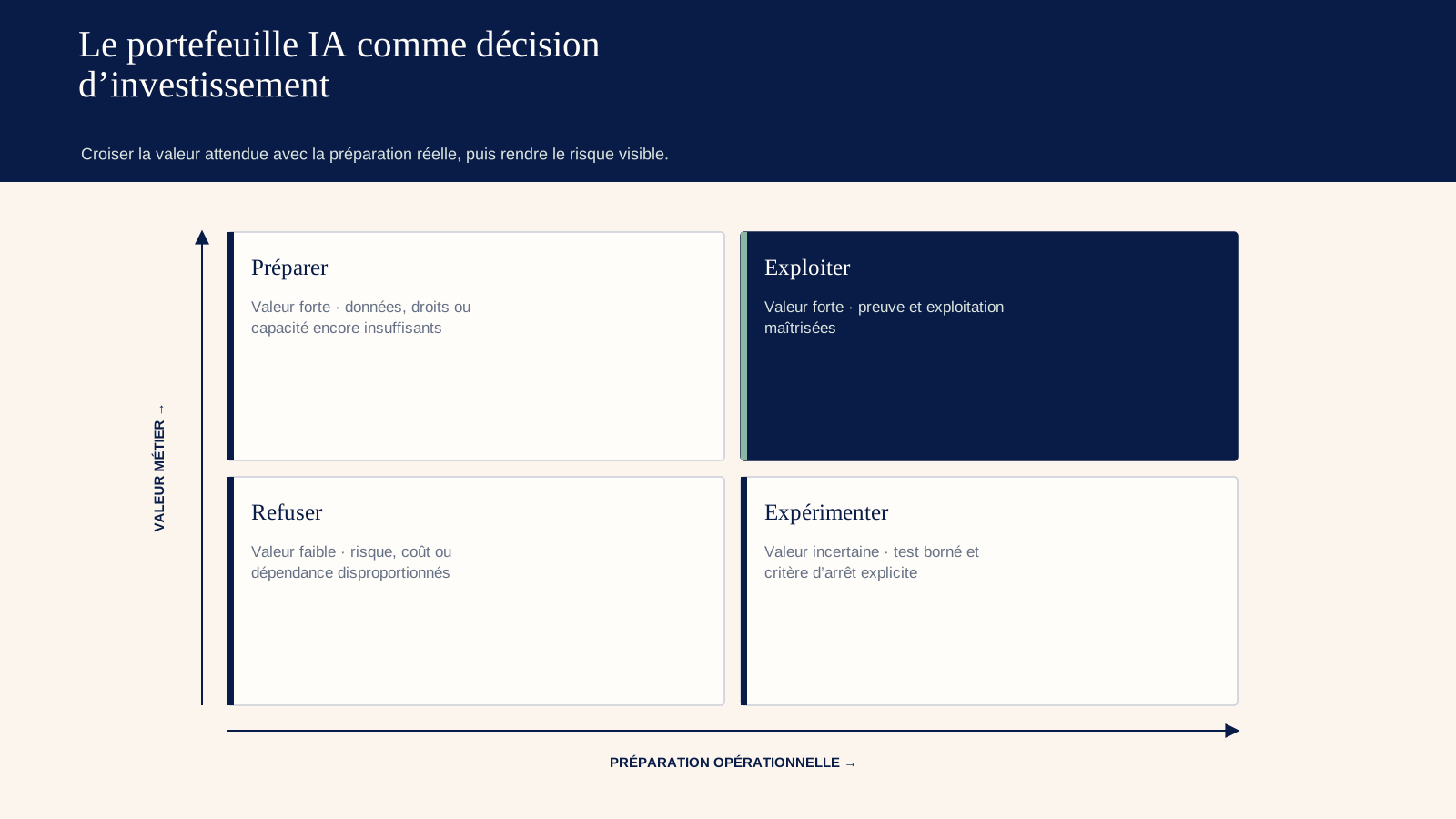
- Operate: repeat value, stable data, controlled risks; scale objective.
- Experiment: strong hypothesis but incomplete evidence; learning budget capped.
- Prepare: plausible value, missing dependency; work on data, process or right.
- Decline/defer: weak economics, disproportionate risk or lack of recourse.
Allocating 50 to 60% of the budget to proven capabilities and uses, 20 to 30% to experiments and the rest to foundations can be a Logiks starting point, never a benchmark. A young company with a core use case can legitimately concentrate more; a regulated group can invest first in inventory and control.
Each initiative has a business sponsor and a service manager. The laboratory is not alone in a transformation whose benefits and errors appear in another department.
12. Governance at three cadences
12.1. Daily — Operate
Monitor quality, availability, costs, incidents, drifts and recoveries. Thresholds make it possible to stop or switch without an exceptional committee.
12.2. Monthly — Learn
Review cohorts, errors, meaningful adoption, operator feedback and net value. Decide to adjust the flow, data, model or level of autonomy.
12.3. Quarterly — Allocate
Compare cases, capabilities, risks and alternatives. Increase, maintain, merge or stop. Update regulatory requirements and timelines.
The three cadences avoid a strategic committee trying to manage a production incident, or an operational team reporting only on a use case that has become structural.
13. Strategic six-month road map
13.1. Month 1 — Inventory and value thesis
Identify official and hidden uses, objectives, data, suppliers and risks. Choose two business constraints where an improvement would have visible value.
13.2. Month 2 — Baselines and evaluation datasets
Measure the current process, build gold-standard datasets, define thresholds and alternatives. Train the committee on the relevant limits and obligations.
13.3. Month 3 — Two contrasting proofs of value
Test a reversible assistance case and a more integrated process case. Keep controls, logging, review and comparison group where possible.
13.4. Month 4 — Reconciliation
Calculate net value, errors, time reallocation and user experience. Discard non-representative results rather than polishing the narrative.
13.5. Month 5 — Operationalise one capability
Move the use case into production with identity, security, monitoring, support and service responsibility. Document exit procedures and fallback mode.
13.6. Month 6 — Review the portfolio
Fund scaling, next learning and the foundations actually reused. Close initiatives without a sponsor or evidence.
Stopping matters. It protects attention.
14. Logiks recommendations: ten signs that there is no strategy
- The roadmap begins with the names of suppliers.
- No current processes are measured.
- All gains are theoretical hours.
- The POC uses only easy examples.
- Errors have no cost or ownership.
- The company confuses declared use with value produced.
- A chatbot, a predictive model and an industrial vision are assessed using the same framework.
- Compliance comes after deployment.
- No exit options are budgeted.
- No pilot is ever stopped.
A serious strategy can say no. Above all, it can explain why.
15. FAQ
15.1. Which use case should you start with?
A frequent, costly, sufficiently stable, verifiable and reversible task, with a business sponsor and available data. Avoid a rare critical decision as the first project.
15.2. How many use cases should you launch?
Enough to learn without fragmenting experts and data. Two or three contrasting proofs of value are generally better than twenty POCs with no owner.
15.3. Do you need an AI platform before launching projects?
No. Build a minimum foundation around a real case, and then standardize the components proven to be reusable.
15.4. How should you calculate AI ROI?
Measure a baseline, a post-deployment result and, if possible, a comparable group. Subtract integration, operation, review, errors, change and incomplete reallocation of time.
15.5. Does generative AI replace predictive data science?
No. Generation, retrieval, classification, forecasting, optimisation and causality respond to different problems. The portfolio chooses the method for the decision.
15.6. Who should own the AI strategy?
Executive management arbitrates; business teams sponsor value; data and IT teams operationalise; legal and security teams oversee; and users help design the work. A centre of expertise facilitates without becoming the owner of everything.
16. Conclusion
The approach does not predict which model will win. It builds a capacity to choose, measure, control and change.
Start with a business constraint. Compare AI with the simplest alternative. Test on a representative dataset. Fund the case on net value. Govern the use case according to its risk. Standardise only the reusable building blocks.
Maturity is demonstrated through decisions.
17. Main sources
- Eurostat, 20% of EU enterprises use AI technologies, 11 December 2025: https://ec.europa.eu/eurostat/web/products-eurostat-news/w/ddn-20251211-2
- Eurostat, The use of artificial intelligence technologies in the European Union — 2026 edition, 26 March 2026: https://ec.europa.eu/eurostat/web/products-statistical-reports/w/ks-01-26-009
- Insee, Artificial Intelligence in Enterprises, 14 October 2025: https://www.insee.fr/fr/statistiques/8616837
- France Num / DGE, France Num Barometer 2025, updated on 7 April 2026: https://www.francenum.gouv.fr/guides-et-conseils/strategie-numerique/comprendre-le-numerique/barometre-france-num-2025-le
- Stanford HAI, AI Index Report 2026: https://hai.stanford.edu/ai-index/2026-ai-index-report
- Brynjolfsson, Li and Raymond, Generative AI at Work, NBER Working Paper 31161: https://www.nber.org/papers/w31161
- Harvard Business School, Navigating the Jagged Technological Frontier, experience with 758 consultants: https://aiinstitute.hbs.edu/navigating-the-jagged-technological-frontier/
- European Commission, AI Act — application timeline, July 2026: https://digital-strategy.ec.europa.eu/en/policies/regulatory-framework-ai
- NIST, AI Risk Management Framework Core: https://airc.nist.gov/airmf-resources/airmf/5-sec-core/
- CNIL, Developing systems of AI: GDPR recommendations, 22 July 2025: https://www.cnil.fr/fr/developpement-des-systemes-dia-les-recommandations-de-la-cnil-pour-respecter-le-rgpd