


A brand identity can be consistent yet invisible. Every presentation may use the same blue, typeface and language as its competitors. Conversely, it can be highly recognisable while remaining tied to a promise that is no longer true.
A brand audit must therefore distinguish between two outcomes: being identified and being chosen.
Distinctiveness makes purchasing easier: people can quickly attribute a piece of content, an interface or a product to the right brand. Differentiation provides a reason to prefer it or pay a premium. Consistency strengthens memory. None of these can be reduced to brand guidelines.
1. Key figures: assessing the availability of brand cues in a crowded market
The World Intellectual Property Organization recorded 15.2 million trademark class applications worldwide in 2024. The five most active offices accounted for 61.5% of filings, compared with 47% ten years earlier. Names and brand cues operate in a dense legal landscape.
The Madrid System received 64,150 applications in 2025, –1.5% year on year. French applicants filed 4,026 applications, placing France fourth in the WIPO figures. These volumes do not indicate whether a particular name is available; they justify a legal clearance search before investment.
An academic study published in 2026 by researchers associated with the Ehrenberg-Bass Institute analyses 1,162 distinctive assets in 21 categories, four countries and nine years. It compares visual, verbal and audio assets, and found that shapes performed particularly strongly in the benchmark. The result does not mean that a form is always superior; it provides an empirical basis for assessing brand cues.
The Ehrenberg-Bass Institute defines a distinctive asset along two dimensions: uniqueness — it evokes only one brand — and fame — enough people associate it with that brand. A colour that the team merely likes is not yet an asset.
Kantar uses three diagnostics for distinctive assets: fame, distinctiveness and intuitiveness. The terminology differs, but the principle is the same: brand guidelines do not prove recognition.
Finally, a Google/Kantar study of UK retail attributed 57% of the future growth observed in its model to differentiation and noted that 69% of UK buyers surveyed said they prioritised price over brand name. These results are specific to the study’s methodology and market. They show that identity must support perceived value, not just aesthetics.
2. The six gaps a brand audit should reveal
- Intention–perception. What leadership intends versus what audiences understand.
- Promise – experience. What communications claim versus what the product delivers.
- Difference–evidence. What the brand claims versus what it can demonstrate.
- Identity–recognition. Cues used versus those audiences attribute to the brand.
- Guidelines–execution. Written rules versus actual touchpoints.
- Creation–protection. Assets receiving investment versus their availability and ownership.
Each gap carries a cost: greater sales effort to explain the offer, confusion, lost conversions, inconsistency, legal risk or inefficient media spend.
3. The scope: a brand is more than what it publishes
Depending on the strategy, the audit covers leadership, employees, customers, prospects, lost customers, partners and candidates. It examines offers, products, content, advertising, sales, service, customer portal, invoices, premises, events and recruitment.
Entities are clarified: corporate brand, product brands, subsidiaries, labels and offers. A portfolio audit may be required if relationships are confused.
The review includes historical context. A long-standing asset can retain valuable memory even when leadership has grown tired of it. A recent change may not yet have had time to become established.
Markets and languages are assessed separately. A name or symbol does not carry the same associations everywhere.
4. Module 1 — Strategic intent
Interviews with leaders and subject-matter teams explore decisions, not adjectives. Questions:
- in which situations do we want to come to mind?
- For whom are we the best choice, and for whom are we not?
- Which problem do we solve better or differently?
- What evidence can we show?
- Which trade-offs will we accept?
- What current perception do we want to maintain?
- What extension would be inconsistent?
The answers are compared. If three leaders define three markets, visual identity will not solve the problem.
Positioning is reformulated as a decision: target, category, tension, promise, reasons to believe, personality and limitations. The words "innovative", "human" and "premium" are insufficient without observable behaviour.
The audit examines the business strategy. Promising a bespoke service while scaling a standardised offer creates a tension that must be addressed explicitly.
5. Module 2 — External perception
Perception is measured through qualitative and quantitative research, depending on the resources available.
Interviews explore unaided recall, situations, comparisons and evidence. Questions avoid simply repeating the brand narrative. "When did you think about this business?" reveals the category entry points.
A quantitative study can measure unaided and aided awareness, consideration, associations, perceived differences, trust and preference. The sample, population and margin are documented.
Existing data provide further evidence: branded searches, reviews, support contacts, CRM records, win/loss reasons, media coverage, social channels and generative search engines. Social listening is not representative of all clients, but detects themes and incidents.
The audit builds a map with four quadrants: associations desired and present; desired but absent; not desired but present; absent and irrelevant. The strategy deals with the two central quadrants.
6. Module 3 — Category entry points
A brand must be mentally available when the need arises. The audit maps buying situations: trigger, moment, context, benefit, constraint and emotion.
For a digital agency: "replace a provider that no longer delivers", "launch an MVP before a funding round", "bring the website into compliance", "explain a complex offer", "regain control of the data".
The content and campaigns are associated with these situations. If all communication is about the company but not the moment of the customer, the brand may be known without being recalled at the right time.
Coverage is measured by the strategic entry points where the brand is associated either spontaneously or when prompted. The aim is not to cover every situation. We must choose those that are compatible with the offer and the evidence.
7. Module 4 — Differentiation and parity
The audit compares direct competitors, substitutes and non-customers. It codes promises, evidence, prices, tone, colours, images, experience and distribution.
A matrix separates:
- category baseline, necessary to be credible;
- claimed difference, present in the speech;
- evidenced difference, observable by the customer;
- valuable difference, which changes the choice;
- defensible difference, difficult to copy quickly.
A clear interface can be a minimum. A method documented with proprietary data can become defensible. A slogan is not enough.
Differentiation does not require an absolute single characteristic. It can come from a coherent set: audience, offer, method, distribution, service and personality. The audit looks for the system as a whole.
Colour comparisons are conservative. A blue sector does not prohibit blue; it requires a sufficiently distinctive combination of assets.
8. Module 5 — Distinctive assets
The inventory covers: name, logo, symbol, colour, combination, shape, pattern, typography, character, sound, slogan, gesture, layout, photography, animation, object and packaging.
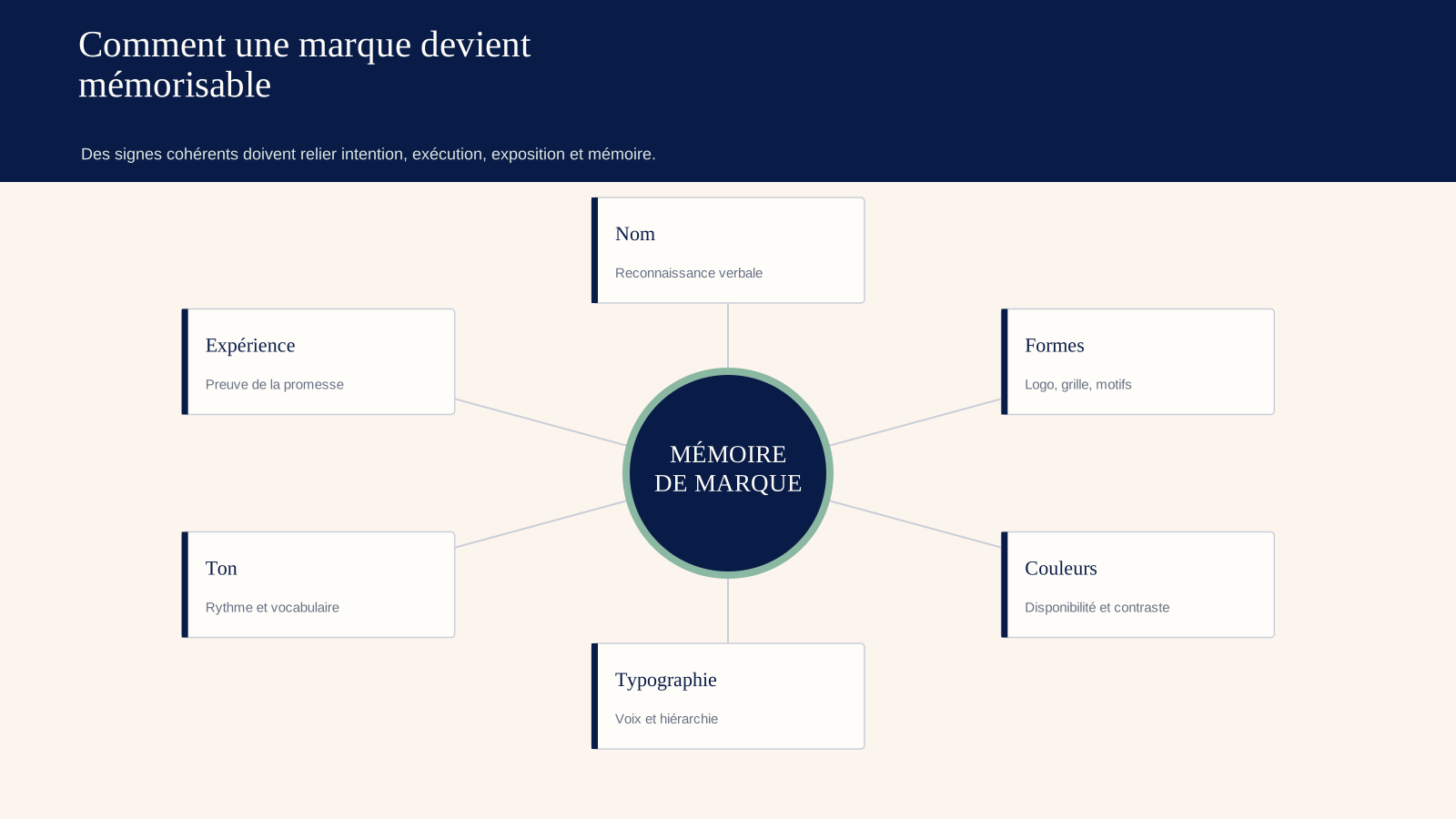
Each asset receives three measures.
Fame. What proportion of the audience associates it with the brand, either spontaneously or from a list?
Uniqueness. Among those who recognise it, what proportion attributes it to the correct brand?
Use. Is it really deployed in a coherent way at the touchpoints?
The tests remove the name. A complete logo that includes the name primarily measures reading. Isolated assets are presented in context, with randomised order where possible.
The matrix places each asset:
- strong and unique: protect and amplify;
- well known but shared: combine or differentiate;
- unique but not widely known: invest consistently;
- weak and shared: stop or redraw.
Rebranding does not automatically remove weak assets. Some need sustained exposure. The audit compares construction cost to potential.
9. Module 6 — System consistency
Consistency does not mean copying the same template everywhere. It means keeping the elements that allow attribution and promise, then adapting to the function.
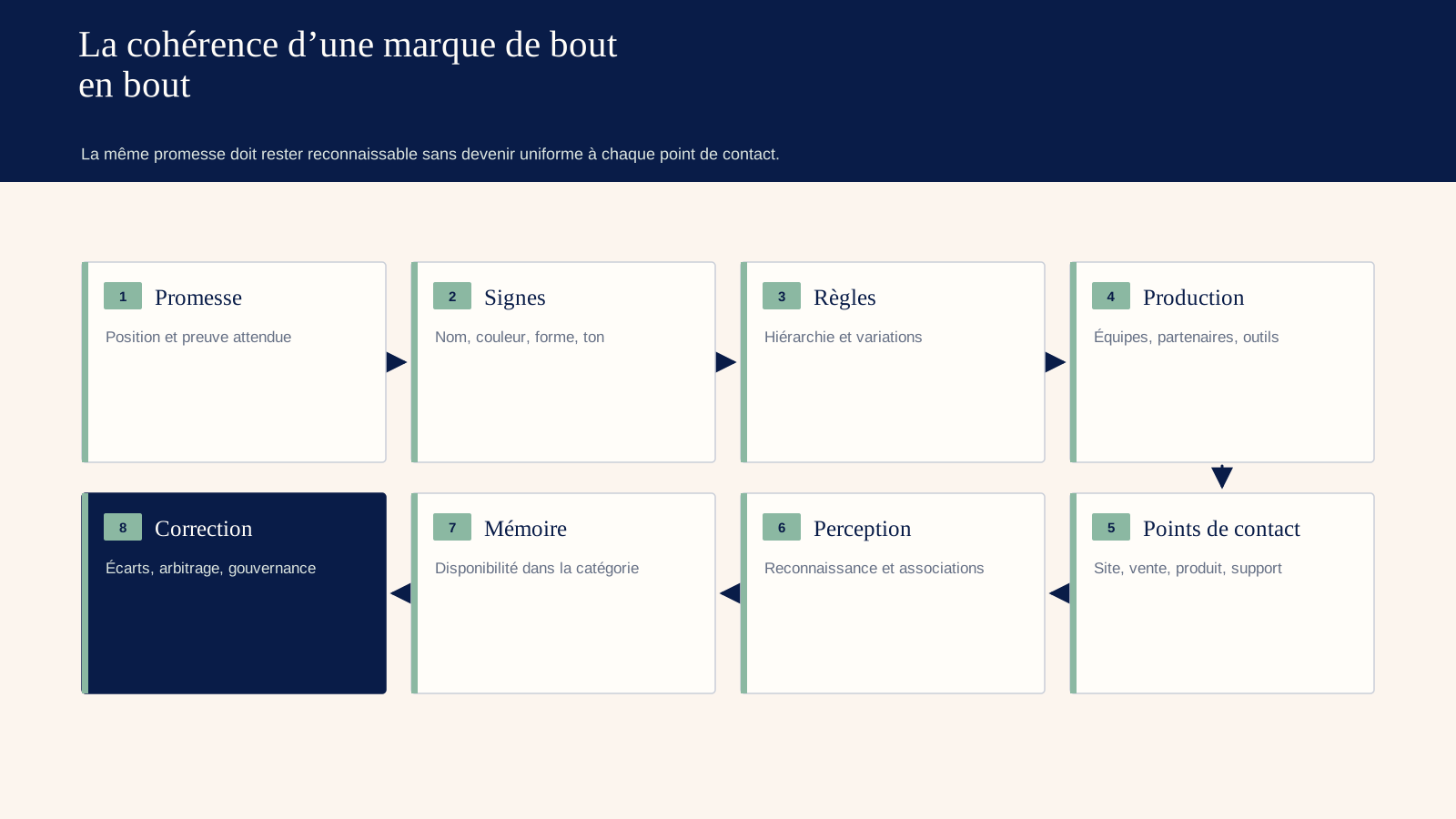
The audit samples at least thirty touchpoints: site, application, deck, advertising, networks, e-mail, estimate, contract, invoice, support, recruitment, event and internal document. Each touchpoint is assessed for: presence of assets, hierarchy, tone, messages, accessibility, quality and compliance.
A consistency score can measure the proportion of critical rules followed. It does not assess aesthetics. Differences are classified as intentional, historical, caused by tooling or capability gaps, or the result of conflicting brand rules.
Templates and libraries are reviewed. A 120-page set of brand guidelines without usable components produces inconsistencies. The system must provide files, tokens, examples, rights and contribution processes.
10. Module 7 — Language and tone
The audit collects titles, arguments, CTA, support responses, proposals, job offers and crisis messages. It looks for distinctive vocabulary, clichés, complexity, evidence and consistency.
The tone is described by tension rather than adjectives: expert without jargon; direct without brutality; ambitious without unverifiable promise; warm without imposed familiarity.
Examples "do/avoid" make the rules applicable. The brand does not write in the same way in a campaign and a payment error, but the personality remains recognisable.
AI-generated content is reviewed. Risk is not only a fault: it is flattening towards a generic tone and producing invented evidence. Prompts do not replace validation.
11. Module 8 — Experience as evidence of the brand promise
The promise is tested across the customer journey. If the brand claims to be simple, how many steps to buy? If it says it is transparent, are prices and limits visible? If it claims to be premium, do the support and deadlines show that?
The audit follows discovery, selection, purchase, onboarding, usage, problem and departure. At each moment, the audit records expectations, emotions, evidence and breakdowns.
A "signature moment" is an interaction capable of embodying the promise: clear diagnosis, packaging, report, service gesture, visualisation or tracking. It must be useful before being spectacular.
Visual consistency does not compensate for contradictory experience. The gap promise–experience is priority because it fuels reviews and word of mouth.
12. Module 9 — Intellectual property and availability
The brand audit is not a legal consultation, but it maps the risk. It verifies registrations, classes, territories, owners, licences, domains, networks, creative contracts and evidence of use.
The name is searched in the relevant databases with an intellectual property counsel for the conclusion. An exact search is not enough; visual, phonetic and conceptual similarities are examined according to categories.
Assets generated or provided by providers must be clearly assigned or licensed. Fonts, photos, music, voices and AI models have their conditions.
WIPO shows the extent of filings, but its database does not replace national and European offices or legal analysis. The audit reports the areas to be investigated.
13. Audit score
Logiks separates nine dimensions: strategic clarity, perception, relevance of entry points, proven differentiation, distinctive assets, consistency, language, experience and protection.
Each score records the evidence, population and confidence level. An opinion of the committee does not give a high perception score. A measure of twenty loyal clients does not represent all prospects.
The overall score is capped if the promise and experience contradict each other on a critical point, or if a central asset presents an unassessed legal risk.
Recommendations are classified as: preserve, amplify, clarify, correct, test, protect or stop. The audit protects assets already held in memory before creating new ones.
14. Case study: a consistent but interchangeable brand
A B2B company uses dark blue everywhere, photos of teams and promise "trust partner for your transformation". The brand guidelines are followed at 92% in the sample. However, interviews combine the same words with four competitors.
The asset test shows that the logo is recognised by customers but by few prospects. A form present in the reports is, however, correctly attributed to the brand by a small group. It is unique but not yet widely known.
The audit does not recommend a complete overhaul. It retains the logo, transforms the shape into the main device and replaces the generic promise with a proven three-step method. Client cases are structured around decisions and outcomes.
A priority entry point – “restarting a stalled digital project” – becomes the thread of a campaign and a page. The measure follows association, brand search, qualified leads and recognition of form over twelve months.
The progress sought goes from colour application to building memory through repetition and evidence.
15. Expected deliverables
- strategic diagnosis and leadership gaps;
- Perception study with limits;
- Map of category entry points;
- parity and differentiation benchmark;
- asset inventory and matrix;
- audit of thirty to one hundred touchpoints;
- diagnostic language and experience;
- property mapping and risks;
- decisions to keep/amplify/correct/stop;
- road map 90 days and 18 months;
- Brand and business measurement table.
The final report includes a "non-negotiable core" of five to ten rules. The rest can evolve.
16. Frequently asked questions
16.1. Does a brand audit always lead to a rebranding?
No. It may recommend consolidating, deploying or restoring assets. Repeat sometimes erases expensive memory.
16.2. How many people should be interviewed?
Qualitative research seeks diversity, not statistical precision. Quantitative sample size depends on the population and required accuracy. The report clearly distinguishes the two.
16.3. Can a colour be a distinctive asset?
Yes if it is sufficiently known and unique in context, often combined with other signs. Internal preference or presence in the brand guidelines is not enough.
16.4. What is the difference between distinctiveness and differentiation?
Distinctiveness enables brand recognition. Differentiation gives a reason to prefer or pay. A brand needs both in proportions suited to its context.
16.5. How often should a brand be audited?
An annual implementation review and active action every one to two years, or before a major transformation. Perception can be followed more often during repositioning.
17. What the audit can conclude about the promise and brand memory
The final report separates four results: familiar assets, correct attribution, perceived associations and actual experience. A strong attribution does not prove preference. A good advertising perception does not prove that the service keeps the promise.
Distinctive-asset tests measure fame and uniqueness. They present colour, shape, character, image style or phrase without name, then count correct answers, competitors cited and lack of attribution. Audiences are separated: clients, prospects and non-clients.
The promise test takes real episodes. It examines what people expected, received, had explained to them and saw put right. Reviews, support tickets, calls, deadlines and refunds complete the declarations. An inconsistency becomes a priority when it comes to an important moment and repeats itself.
Before recommending a redesign, the team must show what signs are already memorised, which are only appreciated internally, which associations actually belong to the brand, where experience contradicts the discourse, what the new management will preserve and how attribution will be followed after migration; without this file, a dramatic change can erase a rare asset while retaining the operational causes that have weakened confidence.
The final matrix crosses memory value, distinction, strategic consistency, performance quality and risk. The resulting decisions are to protect, reinforce, correct, evolve or retire an asset. “Redo the identity” is not a diagnostic category.
Six months after an evolution, the follow-up test repeats the initial protocol. It measures new assets without assuming that exposure is sufficient. Consistent repetition counts more than the volume of replaced files.
The annual review then brings together brand memory and commercial performance: availability in buying situations, consideration, perceived quality, price, conversion, repurchase and recommendation, without merging them into a single score; when an association progresses without changing behaviour, the company knows that it has built a signal but still needs to check distribution, proposition, evidence and experience before assigning too quickly the gap to identity.
The assets withdrawn remain archived with their rights and results. A future team thus understands what has been abandoned by measured weakness, legal constraint or simple campaign choice.
The committee also retains counter-examples. A non-compliant but strongly attributed execution may reveal a poorly documented invariant; it deserves review, not automatic rejection.
The evidence remains traceable.
18. Logiks recommendations
Measure separately what makes the brand recognisable and what makes it preferable. Protect assets already held in memory, confront promise with experience and invest in a small number of distinctive, repeatedly used cues. A strong brand is not defined by perfectly applied brand guidelines; it is reliable memory supported by evidence.
19. Main sources
- Phua et al., Shape-based assets are strongest, study of 1,162 assets, 2026: https://www.tandfonline.com/doi/full/10.1080/02650487.2026.2637295
- Ehrenberg-Bass Institute, Brands of Distinction : https://marketingscience.info/news-and-insights/brands-of-distinction
- Kantar, Distinctive Asset Diagnostic Principles: https://www.kantar.com/north-america/Inspiration/Advertising-Media/What-are-distinctive-assets-and-why-are-they-important
- WIPO, IP Facts and Figures — TrademarksMarch 2026 data: https://www.wipo.int/en/ipfactsandfigures/trademarks
- WIPO, World Intellectual Property Indicators 2025 : https://www.wipo.int/publications/en/details.jsp?id=4822
- Google and Kantar, Differentiation Dividend : https://business.google.com/uk/think/consumer-insights/differentiation-dividend/