


An activated licence does not constitute adoption. A weekly user is not necessarily a proficient user. And ten minutes saved on a task can be lost in verification, coordination or recovery.
Transformation takes place in the work.
1. Definition: adopting AI means changing a work practice with a controlled outcome
AI adoption is a population's ability to integrate a system into defined tasks, to understand its limits, to exercise the necessary control and to produce a better lasting result. It combines access, use, competence, calibrated confidence and performance.
AI change management prepares this transition: task diagnosis, dialogue, training, experimentation, role evolution, assistance, rules and measurement. It is not limited to a launch communication or a rapid workshop.
An organisation can display 80% of active accounts and remain immature if employees copy sensitive data, validate false responses or use the system only for peripheral tasks. Conversely, a smaller population can create a lot of value on a specific and controlled process.
2. Key figures: exposure is increasing, but training remains insufficient
- In 2025, 32.7% of people aged 16 to 74 in the European Union had used a generic AI tool in the previous three months; 15.1% had used one for work, according to Eurostat.
- The France Num Barometer 2025 measures 26% of microbusinesses and SMEs using AI, with 22% for generative AI, but only 5% for task automation. Trying a conversational tool is therefore much more widespread than transforming an operation.
- The OECD reports that in the G7 countries surveyed, less than 30% of SMEs using generative AI provide dedicated training to their employees: from 11.3% in Japan to 29.4% in Canada.
- The ILO-NASK 2025 report, built from almost 30,000 tasks, estimates that 25% of global employment belongs to occupations potentially exposed to generative AI, versus 34% in high-income countries. The ILO insists: exposure does not mean that jobs will automatically disappear.
- The ILO empirical review published in June 2026 concludes that the gains are real but uneven; reported savings of a few percent of working time are not yet systematically translated into higher output, income or employment.
- In the NBER study of 5,179 customer-support agents, the average productivity gain was 14%, rising to 34% among novice and lower-skilled workers, with little effect among more experienced workers.
- Under the AI Act, AI literacy obligations have applied since 2 February 2025. The issue is therefore no longer just educational: the suppliers and deployers concerned must take measures to ensure a sufficient level of AI knowledge, appropriate to the context and the people involved.
These results exclude uniform training. Needs vary with the role, usage, experience and power of action of the system.
3. Step 1 — Make work observable before discussing tools
The conduct of change begins with a task investigation. Ask people what they are producing, what information they are looking for, where work stalls, what they are correcting and which errors concern them.
3.1. Map tasks, decisions and exceptions
For each activity, note frequency, duration, difficulty, variability, dependencies, data, expected output and cost of failure. Distinguish what requires formulation, research, calculation, prediction, negotiation, judgment or responsibility.
This level of detail avoids vague goals such as "automate the legal profession". An AI can compare clauses, provide a summary and pre-fill a sheet; the lawyer retains interpretation, advice, negotiation and responsibility depending on the context.
Observe invisible work, too. Operators build personal lists, ask for confirmation from a colleague, correct data or bypass an interface; integrating a tool without these informal practices shifts errors instead of eliminating them.
3.2. Establish a human baseline
Measure time, quality, recovery, variability and satisfaction on a sample. Ask several people to do the same in order to know the baseline level of disagreement. Future performance will be judged against the current system, not against an abstract human without fatigue or constraints.
A baseline sometimes creates a surprise: the issue presented as an editorial problem actually comes from unavailable information, or the time presented as a saving corresponds to a useful verification task. This discovery is already a value of diagnosis.
First rule: understand before equipping.
4. Step 2 — Build a working coalition, not an enthusiasm campaign
People simultaneously assess usefulness, risk to their profession, the fairness of the change, learning burden and credibility of the sponsor. A communication that recognizes only benefits creates understandable suspicion.
4.1. Represent affected roles
Bring together novice and experienced operators, managers, data/IT, security, legal, HR, support and staff representatives according to the context. Their mission is not to vote on technology, but to identify constraints, acceptable uses, dangerous mistakes and conditions for adoption.
The subject-matter expert becomes co-designer of the evaluation dataset and the rules. This role protects their expertise from simplification and makes visible the edge cases that the supplier does not know.
4.2. Announce what is decided and what remains open
Specify purpose, scope, data, tracking, schedule, expected impact on tasks and the feedback procedure. Explain which decisions remain to be made with the teams. A false consultation after purchase destroys more confidence than a clear, explained decision.
Employment issues must be dealt with directly. The ILO considers that the transformation of tasks is more likely than complete automation, but impacts can remain asymmetrical, in particular for administrative functions, young people and women in certain economies; social dialogue, changes to roles and access to training therefore belong in the plan.
No slogan. A clear contract.
5. Step 3 — Design AI literacy by level of responsibility
Training everyone to the same level is neither useful nor in keeping with the principle of appropriate AI literacy. Logiks recommends four progressive levels.
5.1. Level A — Understand
All users need to know what the system does, what data to avoid, why the response varies, how to recognise uncertainty, where to report a problem and who remains responsible. Examples come from their work.
A 90-minute sequence may introduce concepts and rules, but it does not prove competence. A knowledge quiz must be supplemented by practical cases in which the learner identifies a bad source, rejects a proposed output or corrects an output.
5.2. Level B — Perform well
Practitioners learn to frame a task, provide the authorised context, request a verifiable form, use sources, compare and document. They work on a set of common and difficult scenarios.
The goal is not to write the most sophisticated prompt. Reproducible production is to be obtained in a workflow, with an acceptable verification cost and an abstention rule.
5.3. Level C — Supervise
Managers and AI leads review metrics, errors, drift, population impacts, meaningful adoption and incidents. They know how to decide on human fallback, a reduction in scope or a new assessment.
They also learn not to monitor employees using ambiguous indicators. The number of requests, speed or acceptance of a suggestion is not alone an individual performance measure.
5.4. Level D — Build and govern
Teams that design, integrate or purchase systems learn about data, evaluation, security, the AI Act, GDPR, permissions, suppliers and operations. Their validation is about the complete system, not just the model.
A skill passport links level, usage and date. It expires or must be updated when the function, risks or policy changes.
Training becomes a capacity. Not an event.
6. Step 4 — Establish guided practice in the real workflow
A person may understand in the training room and then forget under pressure. Learning must therefore accompany the first tasks, where errors and questions arise.
6.1. Use pilot cohorts
Choose a representative population, not just enthusiastic ones. Include different levels of experience, sites, languages and constraints. The pilot measures outcomes, verification, confidence and workload, with a comparison group or period where possible.
Harvard described a "jagged technological frontier": an experiment with 758 consultants, GPT-4 significantly improved speed and quality on certain tasks, but could induce incorrect answers when the task was beyond its capacity. The programme thus learns to identify the frontier, not to maximise usage.
6.2. Create short routines
Before: qualify the task and the data. During: retain key sources and checkpoints. After: check for risk, record the correction and report the anomaly. These routines become built-in checklists, templates and controls.
Organize weekly thirty-minute clinics. An AI lead reviews with three real cases, shows an error and updates the library; this format maintains competence better than a large quarterly one-off webinar.
6.3. Protect the right to stop
The user must be able to refuse the suggestion, return to manual handling and report an unsafe output without sanction. If the process makes circumvention impossible to achieve a productivity goal, "human supervision" becomes decorative.
The best learning often comes from an error discussed.
7. Step 5 — Redesign roles, quality and coordination
The time freed must be given an explicit destination. Otherwise, it dissipates, increases expectations or creates an extra load impression.
7.1. Decide how work will be redistributed
A team saves 300 hours monthly on preparation. It can absorb more files, reduce backlog, deepen complex cases, improve customer relationships or reduce overtime; each of these choices produces a different value and organisation.
Review goals, staffing levels, queues, responsibilities and lead times. An automated task can also increase downstream: generating more proposals creates more validation work, while detecting more anomalies mobilises investigators.
7.2. Preserve novice learning
If the system completes all the first steps, beginners may no longer build the necessary representations for advanced judgment. Organize unassisted exercises, explanations, case rotation and a progression of permissions.
The gain of 34% observed in support novices does not imply that their expertise develops automatically. The study finds some suggestive elements of learning, but each organisation must verify autonomy, transfer and performance when assistance disappears.
7.3. Raise the value placed on quality
The human role must not become a mere assembly-line validator. Define when to check, on what signal, with what time and power; review under pressure, where 99% of outputs are mechanically accepted, no longer brings the announced protection.
Transforming work also means transforming its quality system.
8. Step 6 — Measure adoption as a ladder of evidence
A professional table distinguishes six levels.
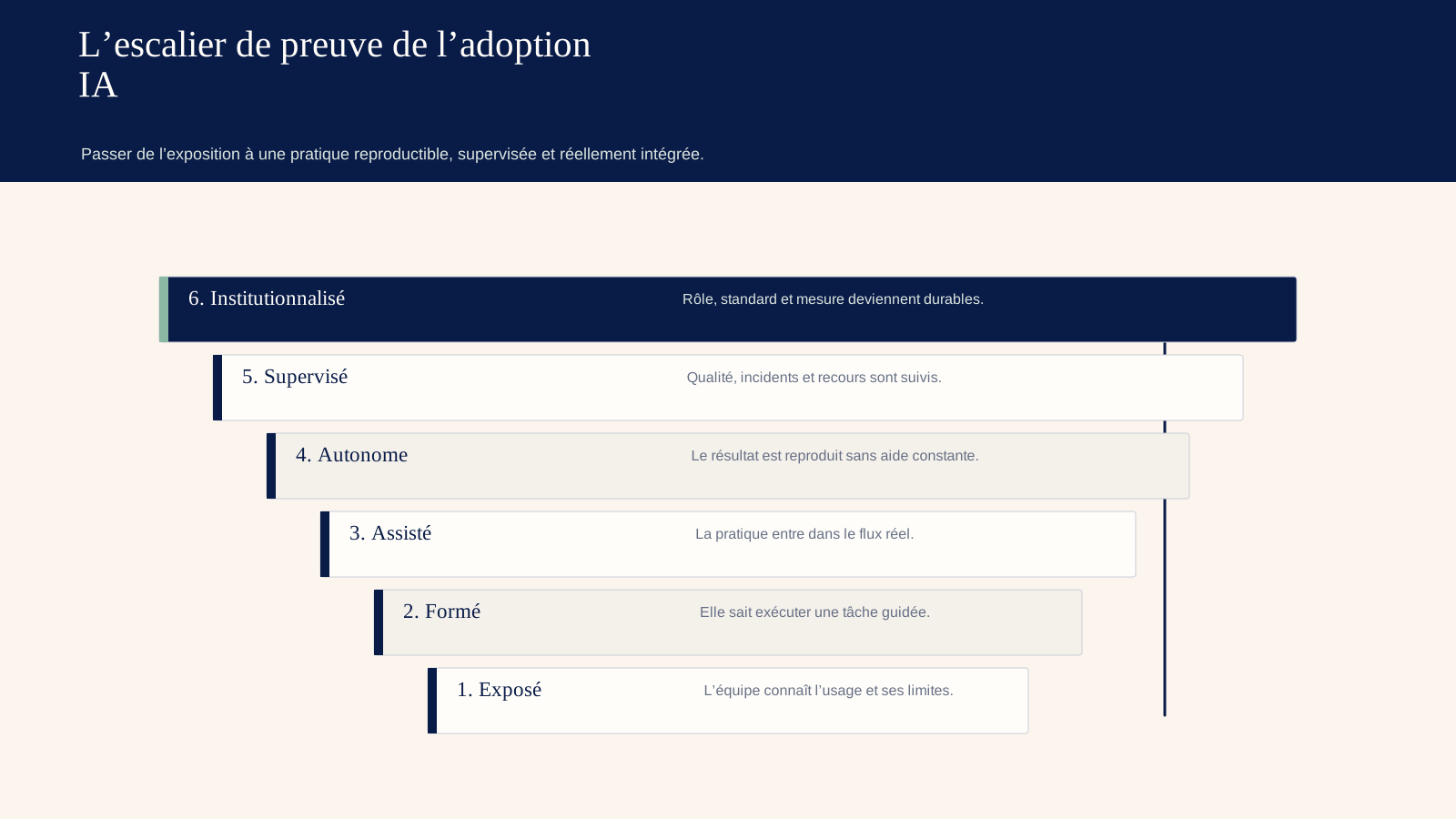
| Level | Indicator | Question |
|---|---|---|
| Access | correct accounts and permissions | Can the population use it? |
| Activation | first task carried out | Have users tried it in the right context? |
| Useful use | eligible tasks processed | Does the tool serve the job? |
| Competence | success on practical cases | Do users understand the limits and apply the required checks? |
| Result | time, quality, capacity | Is work improving? |
| Net value | gains less costs and errors | Does the organisation really win? |
Add equity of adoption: job function, seniority, site, gender when the measure is justified and lawful, disability, language, type of contract. An average gain can mask a population penalized by the interface, training or linguistic quality.
Measure the confidence calibrated with scenarios: does the user accept the right answers, reject the wrong ones and can they say when they cannot conclude? Self-declared confidence sometimes values assurance rather than judgment.
Monitoring data must respect purpose, minimisation, information and rights. Involve HR, legal, the DPO and relevant representatives before turning tool logs into employee evaluation.
9. Quantified example: when task-level time savings can disappear
A 40-person service processes 8,000 monthly requests. The pilot announced a shift from twelve to nine minutes per file, i.e. 400 theoretically freed hours; management could conclude too quickly at the equivalent of more than two full-time positions.
The detailed observation shows the result. Agents save four minutes on writing, but spend an extra minute checking the references and 15% of answers require five minutes of rework; the average net gain becomes 4 − 1 − (15 % × 5) = 2.25 minutes, or 300 hours.
The segmentation then reveals 3.5 minutes earned among newcomers versus 1.2 among experts, many of whom correct the tone and exceptions. Imposing the same speed target would therefore penalise people who handle complex cases and whose corrections precisely improve the common library.
The team chooses three uses for the 300 hours: reduce the backlog by 150 hours, devote 100 hours to proactive reminders and finance 50 hours of review, training and maintenance. It measures two months of response time, first-contact resolution, reopening, satisfaction and perceived burden.
The economic result appears only after this allocation. If the backlog returns, if the reminders reduce the claims and if the review maintains the accuracy, the capacity has a value; if managers simply fill the space with more reporting, the saving remains theoretical.
Another decision concerns novices. For their first four weeks, they use an explanatory mode that shows sources and steps, then complete a sample without assistance; the rise in autonomy becomes a metric, instead of being assumed from speed.
The lesson is sober: measuring the assisted task is not enough. We must follow the complete chain, the populations, the destination of capacity and the capability that will remain after the tool is removed.
Competence remains the goal.
10. The 30–60–90-day deployment plan
10.1. Days 1 to 30 — Listen and measure
Map tasks and populations, establish the baseline, identify hidden uses, bring together the coalition and classify risks. Choose a limited practice with verifiable results.
10.2. Days 31 to 60 — Train and practise
Train by level, launch cohort, install checklists, clinics, support and human fallback. Collect data on errors, time, quality, trust and user experience.
10.3. Days 61 to 90 — Transform and decide
Compare with baseline, reallocate time, modify roles and objectives, correct inequalities, then expand, maintain or stop. Document the lessons learned for the next case.
A Logiks recommendation: no extension to the entire company before the team can show a wrong output, explain how it was detected and prove that the recovery procedure is working.
11. Logiks recommendations: twelve errors in AI change management
- counting licences as adoption;
- recruiting only enthusiastic ambassadors;
- promising time without deciding on its reallocation;
- training only in prompting without training in judgement;
- hiding the employment dimension;
- imposing the tool before establishing a baseline;
- measuring individuals with raw logs;
- forgetting accessibility and languages;
- turning the expert into a repeat validator;
- removing the tasks through which novices learned;
- confusing confidence with acceptance;
- scaling before testing shutdown.
Meaningful adoption is demanding. It respects people because it respects work.
12. FAQ
12.1. How long does it take to adopt an AI tool?
A first work practice can become established in a few weeks. Transforming roles, quality and results requires several business cycles, often three to six months, and then continuous improvement.
12.2. Is two hours of training enough for AI literacy?
Rarely for all roles. It can provide a foundation, but the competence must be case-specific, practised, evaluated and updated according to risks and responsibilities.
12.3. How should you support reluctant employees?
Understand the cause: low utility, perceived risk, lack of time, inaccessible tool or legitimate concern. Treating working conditions is better than labelling the person as resistant.
12.4. Should AI use be mandatory?
Only when the process, training, quality, compliance and recourse are ready. A premature obligation creates shadow workflows and mechanical validations.
12.5. Which KPIs should you track?
Access, appropriate use, competence, quality, timing, recovery, business outcome, net value and disparities by population. The volume of prompts remains a diagnostic indicator.
12.6. How can you avoid shadow AI?
Provide useful tools, understandable rules, a fast approval process and pragmatic training. An inventory process without automatic sanctions helps to correct needs and risks.
13. Conclusion
AI adoption is not decreed from a console. It is built by observing tasks, involving people, learning the limits, and then re-designing the work and its quality.
Measure access, but require competence. Measure the time, but organize its value. Measure averages, but examine segments and errors.
Use is only the beginning.
14. Main sources
- Eurostat, 32.7% of EU people used generic AI tools in 2025, 16 December 2025: https://ec.europa.eu/eurostat/web/products-eurostat-news/w/ddn-20251216-3
- France Num / DGE, France Num Barometer 2025, updated April 7, 2026: https://www.francenum.gouv.fr/guides-et-conseils/strategie-numerique/comprendre-le-numerique/barometre-france-num-2025-le
- OECD, AI Adoption by Small and Medium-Sized Enterprises, 2025: https://www.oecd.org/content/dam/oecd/en/publications/reports/2025/12/ai-adoption-by-small-and-medium-sized-enterprises_9c48eae6/426399c1-en.pdf
- ILO–NASK, Generative AI and Jobs: A Refined Global Index of Occupational Exposure, 20 May 2025: https://www.ilo.org/resource/news/one-four-jobs-risk-being-transformed-genai-new-ilo%E2%80%93nask-global-index-shows
- ILO, The impact of GenAI on jobs, productivity and work organisation, 1 June 2026: https://www.ilo.org/publications/impact-genai-jobs-productivity-and-work-organization-review-empirical
- Brynjolfsson, Li and Raymond, Generative AI at Work, NBER Working Paper 31161: https://www.nber.org/papers/w31161
- Harvard Business School, Navigating the Jagged Technological Frontier: https://aiinstitute.hbs.edu/navigating-the-jagged-technological-frontier/
- European Commission, AI Act — application timeline, July 2026: https://digital-strategy.ec.europa.eu/en/policies/regulatory-framework-ai